7 Open-Source Tools to Help Developers "Tame" AI Agents
Discover 7 open-source tools from The Agency to Nano Chat that will help you transition from a developer to an automated AI system manager.
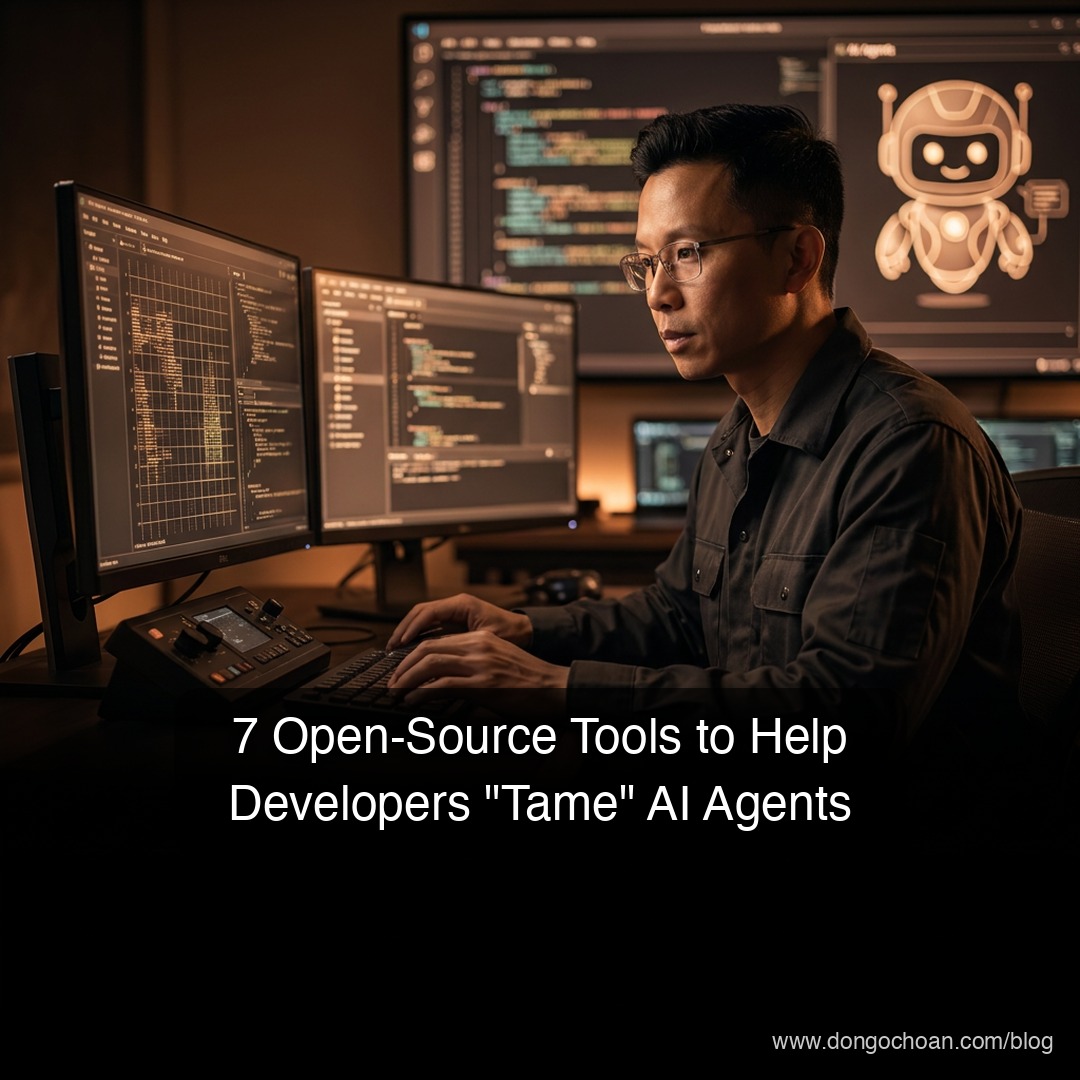
The "Slop Overflow" Era and the Rise of AI Agents
Welcome to the era where a single line of code can trigger a debate among a dozen AI agents over optimization. We are entering the "Slop Overflow" phase—a landscape flooded with AI-generated boilerplates where virtual assistants sometimes suffer from hallucinations. To avoid becoming obsolete, software engineers must learn how to "tame" and orchestrate these AI systems to work for them. Instead of being code typists, developers must transition into system managers.
Here are 7 open-source tools that will help you transform from a developer into the "director" of a powerful, automated AI workforce.
1. The Agency: "Hire" a Free Startup Waitlist
Historically, a Fullstack Developer had to juggle everything from Front-end and Back-end to DevOps and UI/UX. With The Agency, you only need to play the role of CEO.
- What it is: A project offering AI Agent templates for every organizational role.
- Key Features: You gain instant access to AI acting as Front-end engineers, Security experts, Growth Hackers, or even "Twitter engagers" for social media marketing.
- How to use it: Integrate these agents into workflows like Claude Code, and you'll possess an autonomous engine capable of taking a project from zero to a polished product.
2. Prompt Fu: Unit Testing for Prompts
After writing a prompt, have you ever wondered if it is truly optimized? Prompt Fu provides the answer.
- The Core: It functions as a dedicated Unit Testing framework for Prompt Engineering.
- Optimization: Allows you to batch-test various prompt variations across multiple LLMs to identify the most effective instructions.
- Security (Red Teaming): Prompt Fu can simulate hacker attacks to test if your AI is susceptible to leaking API keys or sensitive data under manipulative inputs.
3. Miruish: The AI Multiverse "Oracle"
This is an exceptionally powerful multi-agent prediction engine.
- Mechanism: It scans real-time news, financial trends, and social media, creating a simulated economy where AI agents discuss and react to the data.
- Application: Wondering if an app idea could scale to a billion dollars? Feed it into Miruish to simulate market reactions and formulate the safest product design strategy.
4. Impeccable: Streamlined UI/UX Polish
UI generated heavily by AI often defaults to cluttered layouts or overly saturated, cliché gradients. Impeccable is the lifesaver here.
distillcommand: Simplifies the noisy, over-engineered UIs often produced by AI.colorize&animatecommands: Effortlessly applies professional brand palettes and smooth CSS transitions via a single command constraint, ensuring your app looks as though an expert designed it.
5. Open Viking: "Super Storage" for AI
The biggest fears when employing AI are context amnesia and excessive token consumption. Open Viking resolves this elegantly.
- No Traditional Vector DBs: It organizes the AI's memory and acquired skills directly through the file system.
- Token Efficiency: A multi-tiered data loading architecture significantly reduces token usage. Your AI becomes smarter over time due to intelligent compression and long-term memory refinement.
6. Heretic: Breaking the Manufacturer's Chains
Many language models are heavily censored, refusing to engage with complex topics due to strict alignment policies.
- Obliteration Technology: Eradicates the censorship barriers inherent in models (like Gemma) without the need for expensive fine-tuning or retraining.
- The Result: You gain an unrestricted, compliant AI entirely focused on executing your technical mandates without being hindered by overarching safety filters.
7. Nano Chat: Raising a Homegrown SLM
If you are apprehensive about sharing proprietary data with giants like OpenAI or Google, why not train your own LLM?
- Cost: For roughly $100 in cloud GPU rentals, you can train a Small Language Model (SLM) from scratch.
- Complete Control: You retain full authority over the entire pipeline—from data tokenization to the Web UI. While an SLM may lack the broad general knowledge of GPT-4, it operates with absolute privacy and unparalleled efficiency for specialized internal tasks.
The Bottom Line
In today's landscape, do not strive just to be the fastest keyboard coder. Instead, learn to be the smartest AI orchestrator. Do not let AI make you lazy; use it to free up your bandwidth so you can focus on building larger, more impactful architectures. Which weapon on this list are you most eager to test?
✍️ The Author: Do Ngoc Hoan Founder of CookConnects.ca & Wizy.ca. Bridging the gap between advanced algorithms and business execution. I write for technical founders looking to scale their impact with AI and robust engineering.