From an 8m² Room to National Informatics Champion: My 2006 Story
In 2006 a Vietnamese newspaper profiled a 12th-grader in an 8m² rented room who taught himself Pascal on a second-hand PC — and won the National Informatics Olympiad. The original article, translated, with the original photo.
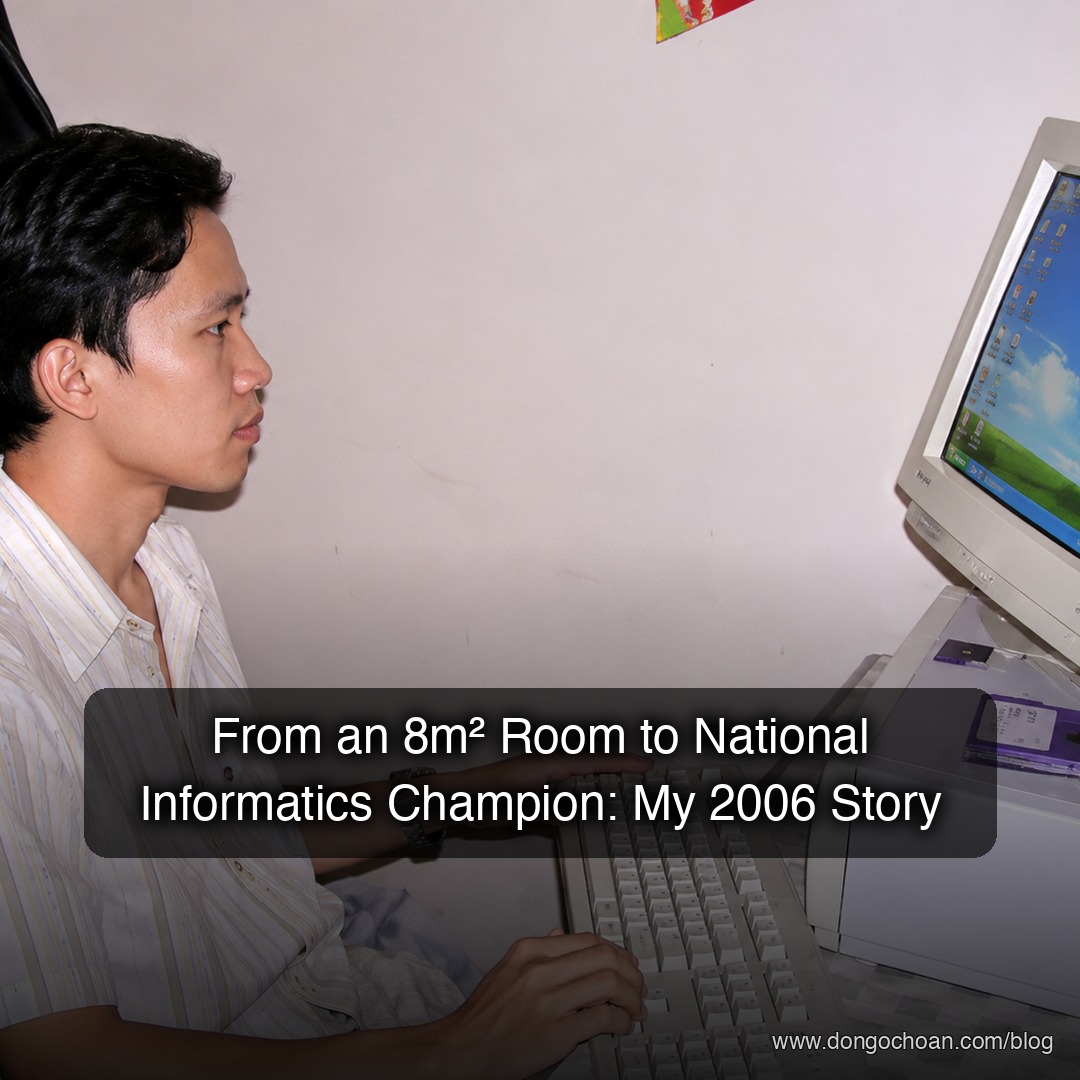
In 2006, the Phú Yên newspaper ran a story about a 12th-grader from the computer-science class at Lương Văn Chánh High School who had just won first prize in Vietnam's National Informatics Olympiad. That student was me. My entire world back then was a rented room of less than 8 square metres: a thin mattress, a desk, and a second-hand computer my parents had saved for a full year to buy.
What follows is a translation of the original article, kept here as a personal archive — along with the original photograph taken that year.
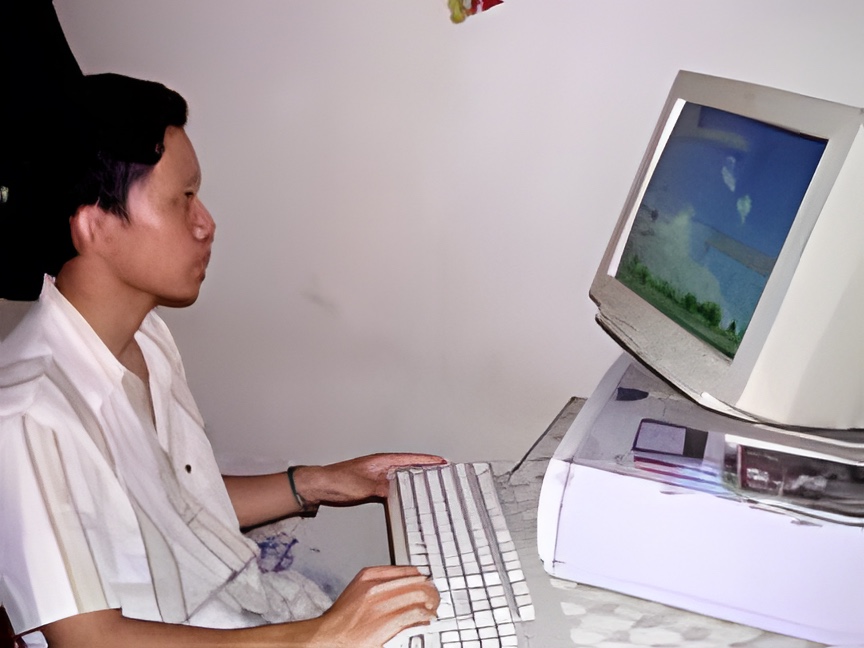
Do Ngoc Hoan — Winner of the National Informatics Prize
A rented room of less than 8 square metres, just big enough for a small mattress and a desk with a computer on it; a guitar hanging on the wall. Tidy, orderly and cramped — that is the "kingdom" of Do Ngoc Hoan. This 12th-grader from the specialised informatics class at Lương Văn Chánh High School has just won first prize in the national informatics competition.
A childhood of changing schools
When he was young, family circumstances forced Hoan to change schools constantly. To make ends meet, his parents moved back to his mother's hometown in Sơn Nguyên to start over. Hoan stayed with his paternal grandparents in Hòa Vinh (Đông Hòa), who took him to first grade at Hòa Vinh Primary School. Missing her son but unable to visit often, his mother eventually brought him to Sơn Nguyên to live with the family. Some time later, they all moved down to Chính Nghĩa hamlet (An Phú commune, Tuy Hòa City).
The constant moves did little damage to his studies. Throughout primary school he was named an all-round outstanding student and was admitted straight into secondary school. Hoan liked the sciences, mathematics above all. In grade 9 he won third prize in mathematics at the provincial gifted-student competition, and dreamed of joining the specialised maths class at Lương Văn Chánh High School. Then, quite by chance, he ended up in the informatics class instead.
From a subject he found dull to a genuine obsession
At first, knowing little about the field, Hoan found informatics unappealing. Attending class twice a day, he gave his major subject little attention — and in grade 10 his results slipped. Ashamed in front of his friends and feeling he had let his parents down, he began pouring himself into the subject.
Outside class hours, Hoan went regularly to the school library to read books on computing. Whenever a classmate owned a book on the topic, he borrowed it — and the more he read, the more it drew him in, almost without his noticing. He hunted for reference material and taught himself on his cousin's keyboard. Because the machine wasn't his, his time on it was short. At public internet shops, he could only afford an hour or two of practice — and skipped breakfast the next morning to pay for it.
A second-hand computer and the first lines of Pascal
Moved by their son's determination, his parents saved for an entire year to buy him a used computer. What he learned in class never satisfied his curiosity, so Hoan went to bookshops for advanced titles and started writing Pascal programs on his own machine. From time to time he wrote a program to play instrumental music in Pascal, plotted graphs in Pascal, and worked through university entrance exam papers.
At the end of grade 11, Hoan won first prize in informatics at the provincial gifted-student competition with a score of 38/40 and earned a place on the national team. He also brought home a silver medal at the Southern Region Olympiad held in April 2005.
Hoan is modest about it: "I've been luckier than my classmate Dũng. He studies far better than I do, but somehow he never wins a prize at competitions. Maybe the pressure gets to him during the exam… For me, every competition is a test of myself and a chance to learn something more."
The national prize, and the road ahead
Winning first prize nationally in informatics earned Do Ngoc Hoan direct admission to university. Even so, the hard-working student is far from satisfied. He still works diligently through university entrance papers and keeps practising his programming.
Mr Vũ Khắc Chung, the homeroom teacher of the grade 12 informatics class who has known him since his first year of high school, says: "Hoan is very hard-working and persistent in his studies. In grades 10 and 11 he wasn't especially strong in informatics. But in grade 12 he put in enormous effort. And the result of that effort is first prize nationally. Of course, he'll have to try even harder to hold his ground on the path he has chosen."
By VÂN ANH — via Phú Yên Online
FAQ
Where does this article come from? It was originally published by Phú Yên Online, written by Vân Anh, about my first prize at Vietnam's National Informatics Olympiad while I was in grade 12 at Lương Văn Chánh High School in Phú Yên province. I archived it on my old Blogspot in 2015 and am republishing it here.
What was my first programming language? Pascal — written on a second-hand computer, used to solve algorithm problems, plot graphs, and even build a small program that played instrumental music.
What were the actual results? First prize in informatics at the provincial gifted-student competition (38/40), a silver medal at the Southern Region Olympiad in April 2005, and first prize nationally in grade 12 — which came with direct admission to university.
Why republish it? As a reminder to myself and to any young person short on resources: an 8m² room and an old machine are enough to start with. The rest is persistence.
References:
- Original archive post: dongochoan.blogspot.com
- Phú Yên Online: baophuyen.com.vn
#Informatics #Vietnam #Pascal #CodingJourney #Olympiad #DoNgocHoan
✍️ The Author: Do Ngoc Hoan Founder of CookConnects.ca & Wizy.ca. Bridging the gap between advanced algorithms and business execution. I write for technical founders looking to scale their impact with AI and robust engineering.