AI Call Recording in 2026: The Vietnamese-English Problem Nobody Warns You About
Mixing Vietnamese and English mid-sentence is exactly what speech AI is worst at. An honest look at the real prices, the accuracy gap, the law — and when to buy nothing at all.
If you finish work calls with half a page of scrawled notes and no idea what you actually agreed to, AI call recording fixes that — it records the call, turns it into text, and hands you a summary with action items. But if your calls are Vietnamese with English terms mixed in ("chốt cái deadline cho sprint này nhé"), the tool you pick matters enormously, because that mixing is the exact thing today's speech AI is worst at. Short verdict: if you take bilingual work calls every week, a dedicated recorder like Plaud earns its price; if your calls are mostly one language and occasional, your phone already does this for free.
The problem is not recording. It's remembering.
Recording a call has been technically possible for twenty years. That was never the bottleneck.
The bottleneck is that a 40-minute call produces a 40-minute audio file, and nobody re-listens to a 40-minute audio file. So the recording sits there, and three days later you still can't remember whether the client said "next Tuesday" or "the Tuesday after."
What people do instead: they type notes while talking. Which means they are half-listening, half-typing, and doing neither well. Or they trust memory, and lose the one detail that mattered — the number, the date, the condition attached to the yes.
What changed recently is not the recording. It's the layer on top: speech-to-text (software that turns audio into a written transcript) feeding an LLM (a large language model — the same kind of AI behind ChatGPT or Claude) that reads the transcript and writes you a summary. That combination turns a dead audio file into something you can skim in ninety seconds.
Three families of solution (in plain English)
There are only three shapes of answer here, and they differ in one thing that matters: where the audio gets processed.
1. Built into your phone. Apple, Samsung and Google all ship this now. You tap record during the call; afterwards you get a transcript and an AI summary in Notes (iPhone) or the Voice Recorder app (Galaxy). Free, zero setup, but tied to what your phone's own AI can do.
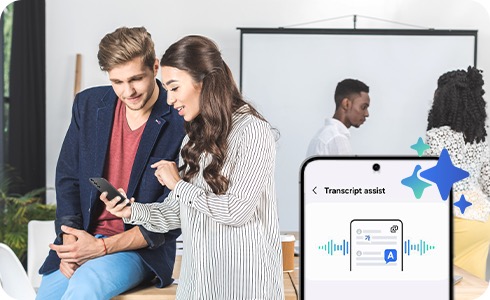 Samsung's Transcript Assist is the built-in path on Galaxy: record with the stock Phone or Voice Recorder app, then transcribe and summarize on-device. (Source: Samsung Support)
2. A third-party app. Truecaller and TapeACall sit on top of your phone's calling. On iPhone, apps like TapeACall have to route the call through a three-way conference (a second, recorded line joins your call) because iOS won't hand a normal app the raw call audio. It works, but it's a workaround, and it shows.
3. A dedicated recorder. A separate piece of hardware — the best-known is the Plaud Note, a credit-card-sized slab that sticks magnetically to the back of your phone.
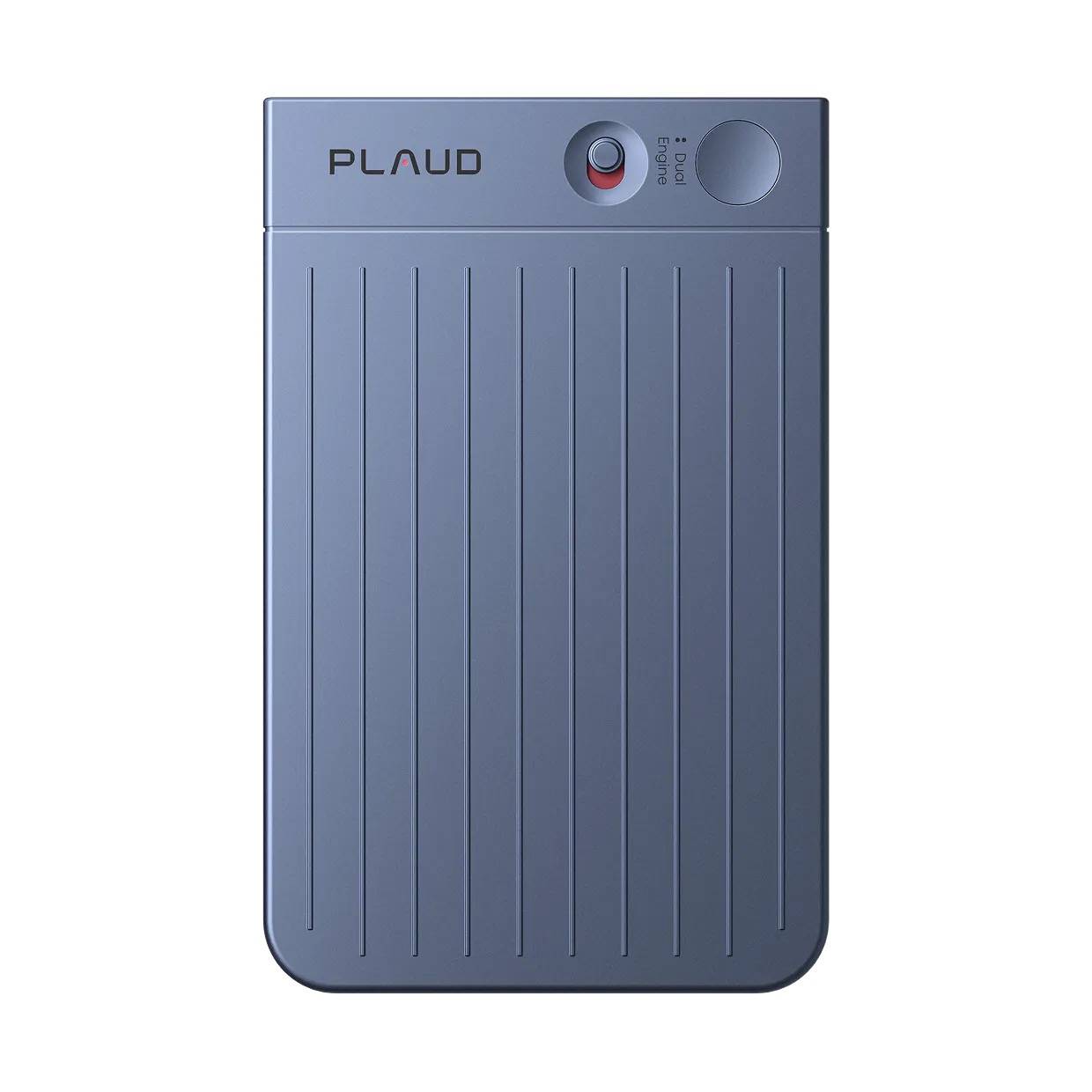 The Plaud Note is about the thickness of two credit cards and lives on the back of your phone. (Source: Plaud)
That third one sounds like the most awkward option — an extra gadget to charge and carry. So why does it keep winning comparisons? Because of how it hears the call.
Why the hardware option keeps winning: it doesn't ask permission
Here's the mechanism, and it's the whole reason this category exists.
A phone app can only record what the operating system lets it record. iOS in particular guards call audio tightly, which is why third-party iPhone recorders resort to conference-call tricks and why quality varies.
Plaud sidesteps the operating system entirely. Attached to the back of your phone, it uses a vibration conduction sensor — it feels the physical vibration of your phone's earpiece rather than listening through the air. Think of it as pressing your ear to a wall to hear the room next door, except it's pressed against the part of your phone that is physically producing both sides of the conversation. No microphone picking up your speaker with echo and room noise. No permission to be denied.
So what: you get both halves of the call cleanly, on iPhone and Android alike, without depending on what Apple or Samsung decided to allow this year.
Then the audio goes to the cloud, where a large multilingual speech model transcribes it and an LLM writes the summary.
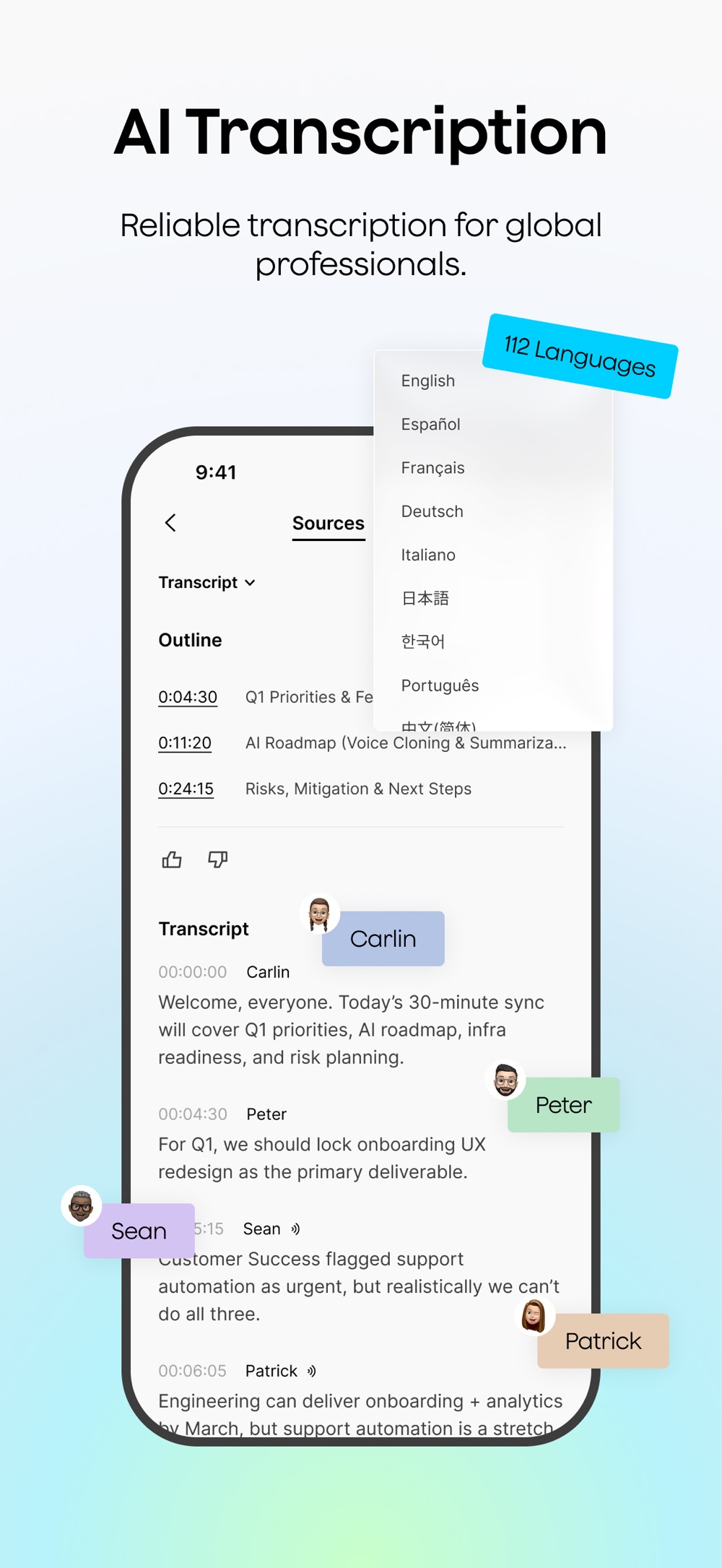 112 transcription languages and automatic speaker labelling — the cloud-model advantage over on-device processing. (Source: Plaud on the App Store)
The bilingual part — where most of this quietly falls apart
This is the section worth reading twice if your calls sound like: "Anh gửi em cái proposal, mình review rồi chốt scope trong tuần này."
Linguists call that code-switching — swapping languages mid-sentence. It is completely normal in Vietnamese professional speech, and it is a genuinely hard problem for speech AI, not a marketing softness.
Two reasons:
Vietnamese is tonal; English is stress-based. A Vietnamese word changes meaning with its tone. An English word changes shape with its stress and the speaker's accent. A model listening for one pattern is not listening for the other, so English terms dropped into a Vietnamese sentence often come out as a same-sounding Vietnamese word instead.
Most systems commit to one language up front. On-device features like Samsung's Transcript Assist run from a downloaded language pack. Pick Vietnamese, and the engine is looking for Vietnamese — so an English technical term only survives if it happens to sit in that pack's vocabulary.
Cloud models handle this better because they are genuinely multilingual and can auto-detect. But better is not solved. Published research on Vietnamese–English code-switching is blunt about it: modern models including Whisper-class systems still struggle with code-switched speech, and accuracy is best when the audio is predominantly one language. Whisper-Large-v3 posts the lowest error rates on code-switched stretches — but "lowest" is not "low."
⚠️ Treat every vendor claim of flawless bilingual transcription as marketing. On a 70% Vietnamese / 30% English call, expect the Vietnamese to be solid, common English business words to survive, and specialised jargon and product names to get mangled some of the time — on any tool you buy. Plan to skim and fix, not to trust blindly.
The practical difference between tiers is therefore narrower than the marketing suggests: cloud-model tools degrade gracefully on mixed speech, on-device single-language engines degrade sharply. That gap is real, and it is what you're paying for.
What you actually get for the money
Assume the transcript is 90% right rather than 100%. Is it still worth it? For a working week of calls, yes — here's the concrete return.
- A searchable record instead of an audio file. Text you can Ctrl-F six weeks later, when the question is "what did we agree the payment terms were." So what: the disagreement ends in thirty seconds instead of a defensive email thread.
- A summary with action items, not a wall of text. The AI extracts decisions and to-dos. So what: you leave a call with a task list you didn't have to write.
- Speaker labels. The transcript marks who said what. So what: on a four-person call, "who committed to that" is answerable.
- Your attention back. You stop typing during calls and start listening. So what: this is the benefit people underrate and notice most after two weeks.
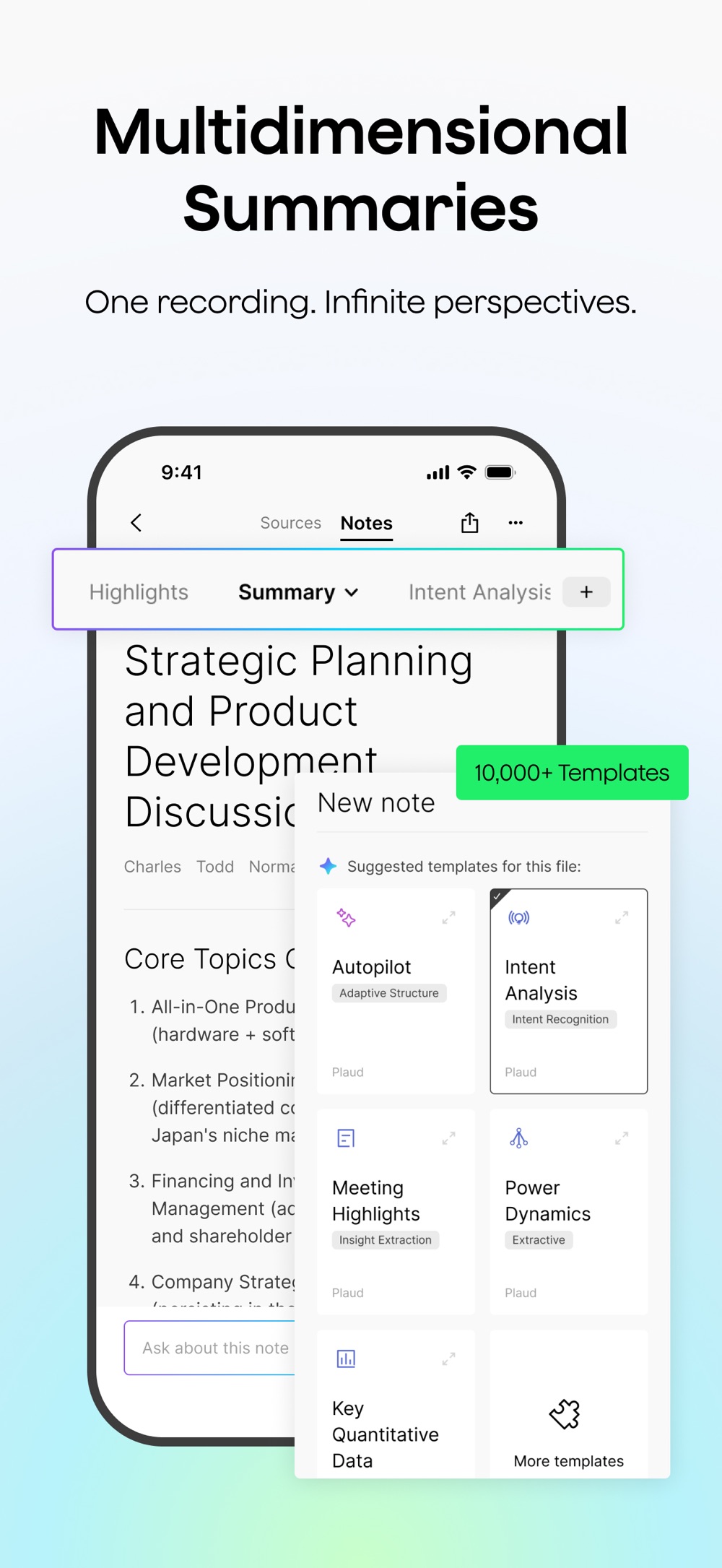 One recording, several summary shapes — meeting highlights, action items, or a custom template. (Source: Plaud on the App Store)
What it costs you — including the parts nobody advertises
Money. The Plaud Note is $159 and the Note Pro $189, one time. Every device includes a free Starter plan with 300 transcription minutes per month — about five hours, which genuinely covers light use. Beyond that, Pro is $8.33/month billed annually (~$99.99/year) for 1,200 minutes/month, and Unlimited is $19.99/month. Truecaller Premium is around $3.99/month in the US and ₹529/year in India. The built-in phone features are free.
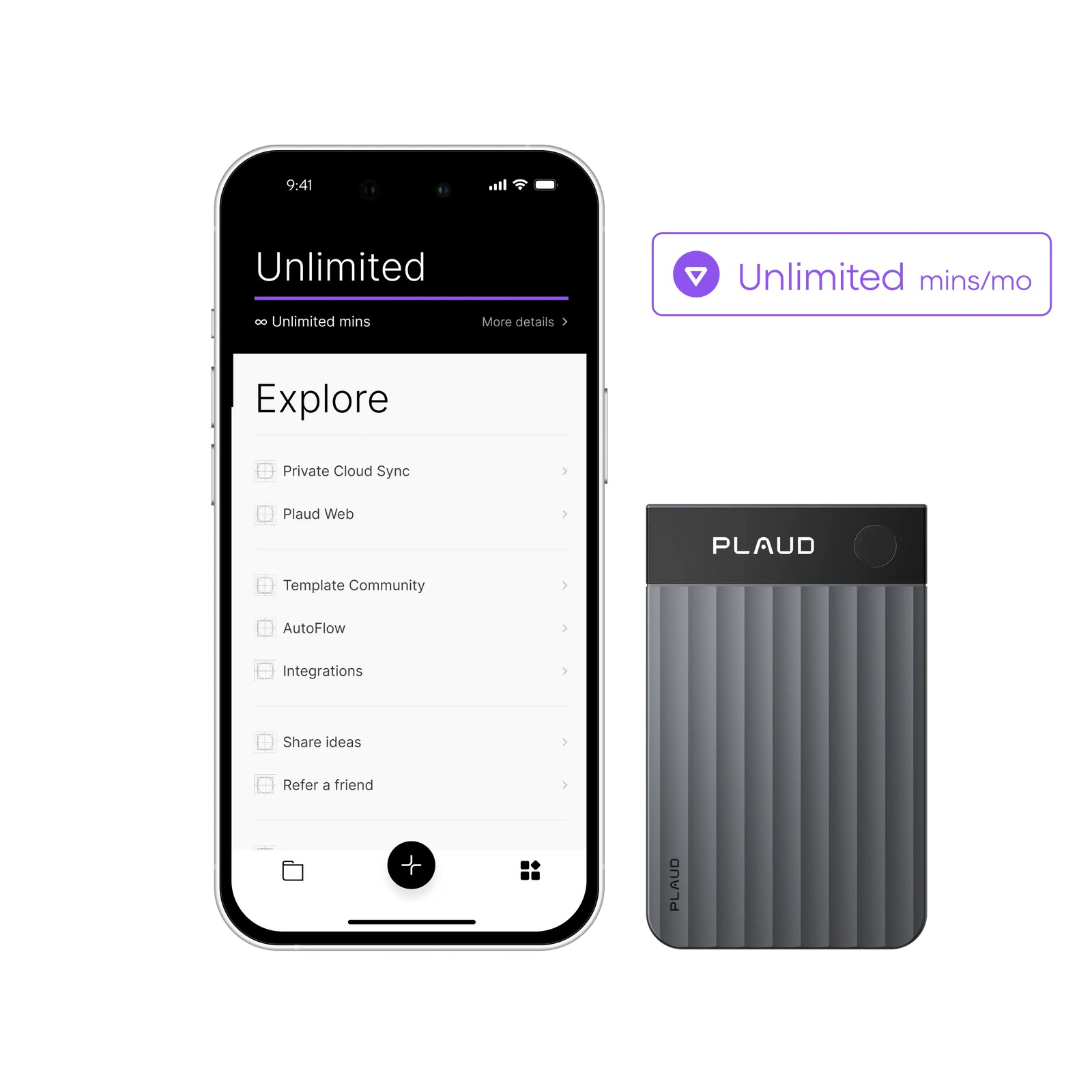 Minutes per month is the real unit of cost in this category — the hardware is a one-off, the transcription budget renews. (Source: Plaud)
An announcement the other person hears. This is the cost that surprises people. When you record a call using the iPhone's built-in feature, all participants automatically hear a spoken announcement that the call is being recorded, and it replays periodically. It cannot be turned off, in any country, by any setting. That is a deliberate Apple design decision, not a bug — and it changes how the other person talks. If you wanted quiet note-taking, the built-in iPhone route is not it.
Availability gaps. Apple's call recording is not offered at all in the EU and roughly nineteen other countries. Check Apple's feature-availability page before you plan around it.
The law, which is not optional. In Vietnam, the Personal Data Protection Law 2025 prohibits recording a call without the consent of the person on the other end, save for cases the law specifically provides for. Administrative fines start in the range of 10–20 million VND under Decree 15/2020/NĐ-CP and can go higher, with orders to delete the data. Canada and most of the US are more permissive (one-party consent in many jurisdictions), but "permissive" varies by province and state.
⚠️ The honest version: the technology makes silent recording easy, and the law in Vietnam does not care that it was easy. Tell the other person you're recording. It costs you one sentence at the start of the call, and it removes the entire risk.
When this is clearly worth it
- You take client or vendor calls where numbers and commitments get agreed verbally. The transcript is your record.
- You take calls in a language you're still building fluency in. Re-reading beats re-listening.
- You run a small team and calls are where decisions actually happen. The summary becomes the meeting minutes nobody was going to write.
- You take calls while driving or walking and physically cannot take notes.
When you should NOT buy anything
This section matters more than the last one.
- Your calls are short and social. Five-minute calls do not need an AI pipeline. Do nothing; the value isn't there.
- You take maybe two work calls a week. Your phone's built-in recorder is free and adequate. Buying $159 of hardware for eight calls a month is a hobby purchase, not a productivity one.
- Your calls are in one language only. The main advantage of the paid cloud tier is graceful handling of mixed speech. If everything is Vietnamese, or everything is English, Samsung's or Apple's on-device transcription is close enough and costs nothing.
- Your conversations are confidential in a way that matters — legal, medical, HR, or anything under NDA. A dedicated recorder sends audio to a vendor's cloud for processing. Plaud holds ISO 27001, SOC 2 Type II, GDPR and HIPAA compliance, which is a real answer, but "compliant vendor" is still a third party holding the recording. If that's unacceptable, the on-device options are the safer architecture, and taking no recording at all is safer still.
- You need it to be invisible. Nothing here should be used to record someone who hasn't been told — see the section above.
Comparing the real options, including doing nothing
| Do nothing (notes by hand) | Built-in (Apple / Samsung / Pixel) | Third-party app (Truecaller, TapeACall) | Dedicated recorder (Plaud) | |
|---|---|---|---|---|
| Cost | Free | Free | ~$4–10/month | $159–189 + free 300 min/mo, or ~$100/yr |
| Setup | None | None | App install, permissions | Charge it, pair it, stick it on |
| Language handling | Your ears | On-device pack; Vietnamese supported by both Apple (iOS 26.1) and Samsung | Follows regional/manual config | Cloud multilingual, 112 languages, auto-detect |
| Mixed VI–EN speech | Perfect (you understand it) | Degrades sharply on jargon | Weakest of the three tech options | Degrades gracefully — best available, not flawless |
| Both sides of the call | n/a | Yes | Varies; iOS needs a conference workaround | Yes, via vibration sensor |
| Announcement to the other party | n/a | Yes on iPhone, unavoidable | Varies | No built-in announcement — telling them is on you |
| Privacy | Total | Mostly on-device | Vendor cloud | Vendor cloud (ISO 27001 / SOC 2 / HIPAA) |
| Best for | Short, social, or confidential calls | Occasional single-language calls | Screening spam and light recording | Frequent bilingual work calls |
📺 Is Plaud Note Pro REALLY worth the hype? — That Mark Gilroy
The verdict
- Adopt the hardware if you take bilingual work calls most weeks and decisions get made on them. Start with the free 300 minutes/month before paying for a plan — five hours a month is enough to find out whether you actually use it.
- Use what's already on your phone if your calls are occasional or single-language. Apple Intelligence supports Vietnamese as of iOS 26.1, and Samsung's Transcript Assist supports it on-device. Free is the right price for that use case.
- Buy nothing if your calls are short, social, or confidential. Hand notes are still a valid answer, and for confidential conversations they're the better one.
- Whatever you choose, say out loud that you're recording. One sentence, no legal exposure, and it costs you nothing that matters.
FAQ
Do I need this if I only take a few work calls a week? No. Your phone's built-in recorder covers that for free. The paid tier starts making sense when calls are frequent enough that you'd otherwise be typing notes during them.
What does it actually cost per year? Hardware $159–189 once, then $0 if 300 minutes/month is enough, or roughly $100/year for 1,200 minutes/month. App-based options run about $4–10/month with no hardware.
Is my 70% Vietnamese / 30% English call going to transcribe cleanly? Mostly, not perfectly. Expect the Vietnamese to be reliable, common English business words to come through, and specialised jargon to need correction. Cloud tools handle it noticeably better than on-device ones — but no tool available today solves code-switching.
Is it legal to record a call in Vietnam? Not without the other person's consent. The Personal Data Protection Law 2025 prohibits recording calls without the data subject's agreement, and fines under Decree 15/2020/NĐ-CP start around 10–20 million VND. Ask first; it's a one-sentence fix.
What breaks if we skip all of this? Nothing dramatic — you keep taking notes by hand and occasionally lose a detail. That's the honest baseline. The question is whether the details you lose are expensive ones.
References
- Plaud — plans and pricing
- Plaud Support — transcription languages
- Apple Support — Record and transcribe a call on iPhone
- Apple Support — How to get Apple Intelligence (languages and regions)
- Samsung — How to use Galaxy AI Transcript Assist
- Truecaller call recording and transcription — TechCrunch
- Whisper-based cross-lingual phoneme recognition between Vietnamese and English (arXiv)
- Bộ Công an — Luật Bảo vệ dữ liệu cá nhân 2025
#AICallRecording #Plaud #AppleIntelligence #GalaxyAI #SpeechToText #CodeSwitching #VietnameseTech #Productivity #AITools #DataPrivacy
✍️ The Author: Do Ngoc Hoan Founder of CookConnects.ca & Wizy.ca. Bridging the gap between advanced algorithms and business execution. I write for technical founders looking to scale their impact with AI and robust engineering.