Codex 5.6 Sol vs Terra vs Luna: Picking the Right Model for Every Task
OpenAI's Codex now ships five model tiers named after the sun and planets — here's exactly which one to reach for on every coding task.
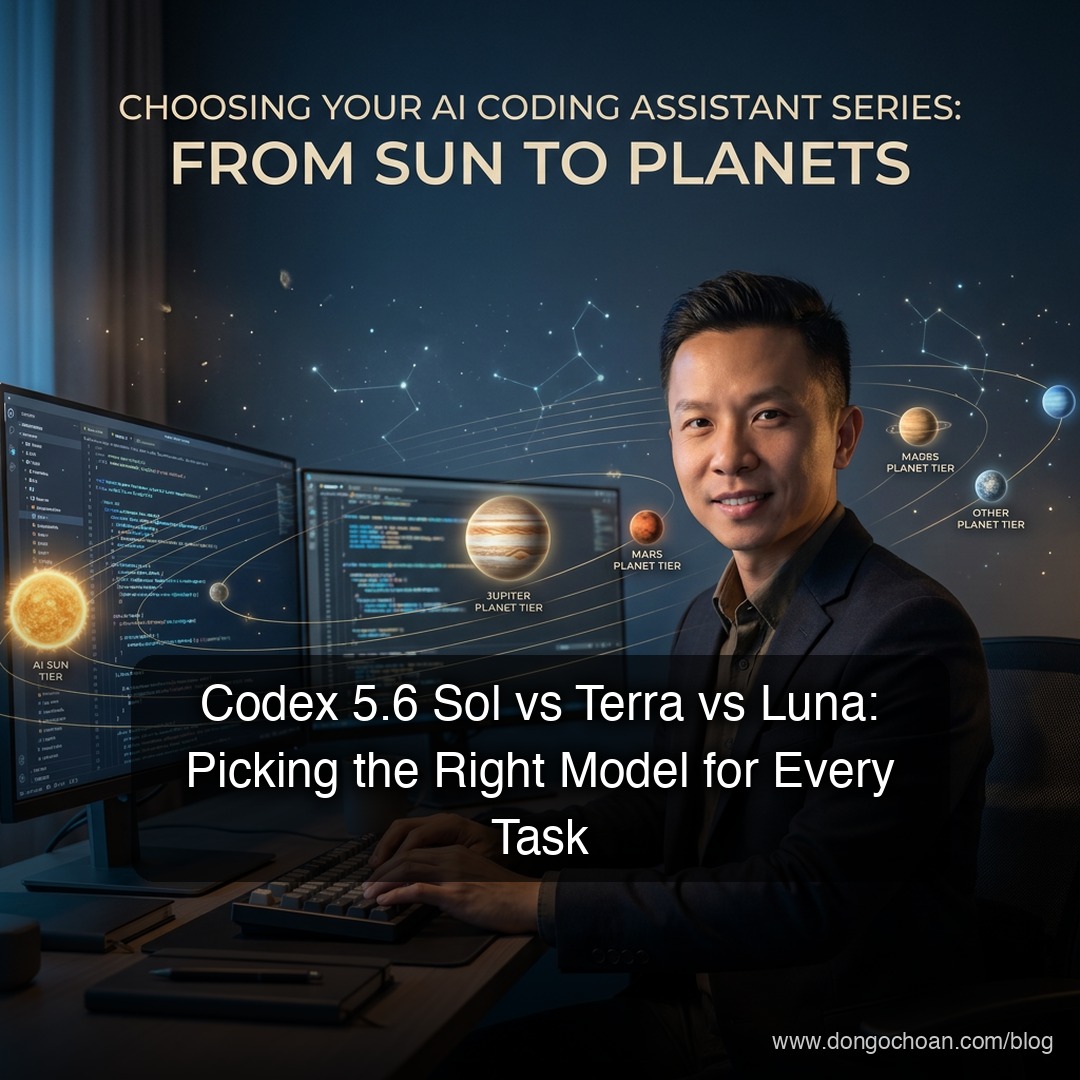
OpenAI's Codex now ships five model tiers, and the naming has quietly shifted away from plain version numbers toward names borrowed from the solar system — Sol, Terra, Luna. If you're picking a default model for a real project instead of just accepting whatever's selected, here's the actual difference between each tier and when to reach for it.
What are Codex's Sol, Terra, and Luna models?
They're three tiers of the same 5.6 generation, split by depth of reasoning versus speed:
- 5.6 Sol — the flagship, tuned for the hardest agentic coding work.
- 5.6 Terra — the balanced workhorse for everyday coding.
- 5.6 Luna — the fast, cheap tier for lightweight, repetitive tasks.
Alongside them sit two older options still worth knowing: 5.5, the previous stable generation, and 5.3 Codex Spark, a tier built specifically for rapid-fire quick fixes.
When should I use Codex 5.6 Sol?
Sol is the model to reach for when the cost of being wrong is high. It's built for deep reasoning and system-level debugging, and it can read and reason across a large repository's full structure without losing context along the way. Reach for it when you're architecting an application from scratch, tracking down a hard logic bug, or running a long autonomous agent chain where accuracy matters more than speed. The trade-off is response time — Sol thinks longer to get it right.
When should I use Codex 5.6 Terra?
Terra is the default for day-to-day coding. It responds faster than Sol while keeping strong reasoning quality, and it handles the bulk of routine work smoothly — writing functions, refactoring, generating test scripts. If you're not sure which model to pick for a normal feature or bug fix, Terra is the safe everyday choice.
When should I use Codex 5.6 Luna?
Luna trades reasoning depth for speed and cost. It's the tier to use for quick explanations, format conversions (JSON to a type definition, for example), lint or typo fixes, and short one-off scripts — anything where you need an answer instantly and the task doesn't require deep logical work.
What about 5.5 and 5.3 Codex Spark?
5.5 is the previous stable generation — proven over time, with fewer of the rough edges that can show up in newer alpha or beta releases, but a smaller context window and less autonomy than the 5.6 line. 5.3 Codex Spark is tuned for the fastest possible dev loop: small patches, narrow refactors, and staying in flow when you're racing a deadline and just need code typed out without long AI "thinking" pauses.
How do I choose the right Codex model for my project?
Match the model to the size of the decision, not the size of the task list:
- Large automation flows or database-level architecture work — stay on 5.6 Sol. The extra reasoning time pays for itself when a mistake would be expensive to unwind.
- Everyday UI work and standard API endpoints — switch to 5.6 Terra for a faster response loop without giving up reliability.
- Quick syntax fixes and tiny scripts — drop to 5.6 Luna or 5.3 Codex Spark to keep moving without waiting on a model that's overqualified for the task.
FAQ
What is the difference between Codex 5.6 Sol, Terra, and Luna? Sol is the flagship for complex agentic coding and deep debugging, Terra is the balanced daily-driver, and Luna is the fast, low-cost tier for lightweight and repetitive tasks.
Is Codex 5.6 Sol better than 5.5? Sol is the newer, higher-reasoning flagship with a larger effective context window; 5.5 is the older stable release, valued for its consistency rather than raw capability.
What is 5.3 Codex Spark used for? It's tuned for the fastest dev loop — quick patches and small refactors — prioritizing instant code output over deep reasoning.
Which Codex model should I use for a large project like a database-heavy automation system? 5.6 Sol, since it's built to hold context across a large repository and handle complex, high-stakes logic without losing track of the codebase.
Do I need to manually switch Codex models for each task? Yes — treating Sol, Terra, and Luna as interchangeable wastes either speed or accuracy. Match the tier to the task's complexity as outlined above.
✍️ The Author: Do Ngoc Hoan Founder of CookConnects.ca & Wizy.ca. Bridging the gap between advanced algorithms and business execution. I write for technical founders looking to scale their impact with AI and robust engineering.