Codex Record & Replay: Show It Once, It Automates Forever
OpenAI's Codex can now watch you do a task once, then turn it into a reusable skill it runs on its own. "Show, don't tell" automation has arrived on macOS — and the generated skill isn't a black box.
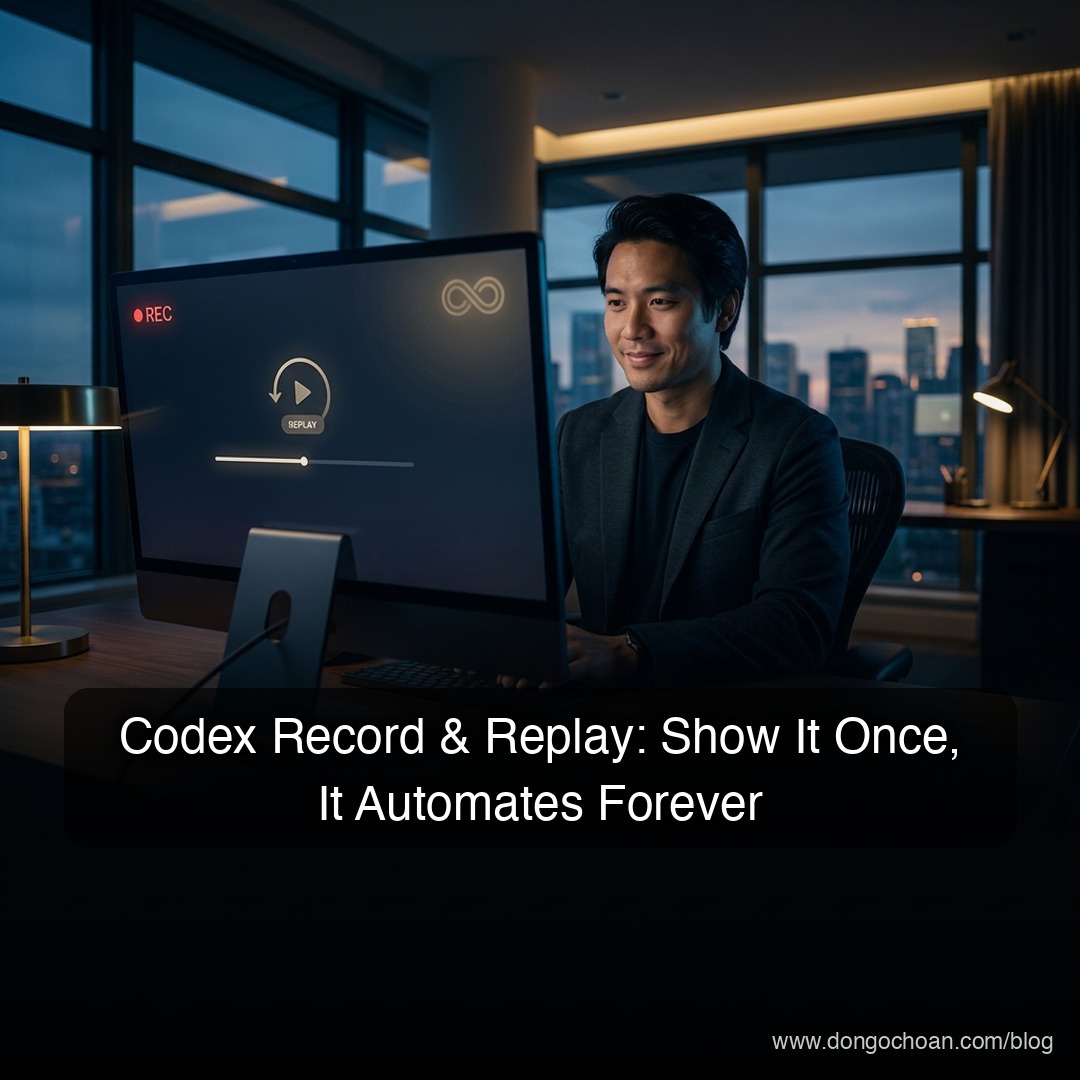
OpenAI just shipped a feature that quietly redefines what a coding agent is. Record & Replay for Codex, now live on macOS, lets you perform a task once while Codex watches — then it converts your actions into a reusable skill that runs the entire workflow on its own. It's the "show, don't tell" model of automation, and it signals Codex's evolution from a coding assistant into a general-purpose automation agent for everyday computer work.
1. The Core Idea: Demonstration Over Instruction
For years, automating a workflow meant describing it — writing a script, defining triggers, mapping out every conditional branch. Record & Replay flips that on its head. Instead of telling the machine what to do step by step, you simply do the task once and let Codex learn by observation.
The loop is deliberately simple:
- Start recording.
- Complete the task normally — exactly as you would on any other day.
- Stop recording.
That's it. From that single demonstration, Codex generates a structured workflow it can replay on demand.
2. What Codex Actually Captures
This is where Record & Replay moves beyond a dumb macro recorder. The generated workflow isn't just a blind sequence of clicks and keystrokes. Codex structures it into three meaningful layers:
- Required inputs — the variables your task depends on (a file, a date, a recipient, an amount).
- Execution steps — the ordered actions that move the task from start to finish.
- Verification checks — built-in confirmations that the workflow actually succeeded, not just that the buttons got pressed.
That third layer is the real differentiator. A traditional macro breaks silently the moment a window shifts or a page loads slowly. By baking in success checks, Codex aims to produce automations that know whether they worked — a prerequisite for trusting them with anything that matters.
3. The Skill Isn't a Black Box
The most important design decision here is transparency. The skill Codex generates is fully inspectable. You can open it, read exactly what it intends to do, edit any step, and customize the behavior however you want.
This matters more than it sounds. Black-box automation is a liability — you can't debug what you can't see, and you certainly shouldn't grant it access to your expense reports or production tickets. By keeping the generated skill open and editable, OpenAI turns each recording into a starting draft rather than an opaque, take-it-or-leave-it artifact.
4. What You Can Actually Automate
Because Record & Replay operates at the level of your actual desktop, the range of tasks is broad — essentially any routine you repeat on your computer:
- Uploading videos to YouTube
- Handling recurring social media tasks
- Creating tickets from templates
- Submitting expense reports
- Requesting time off
- Downloading recurring reports
- Automating repetitive coding workflows
The common thread: high-frequency, low-variation chores that drain time precisely because they're too small to justify building a "real" integration for. Record & Replay collapses that build cost to a single demonstration.
5. The Bigger Shift: Codex as an Automation Agent
Step back and the strategic direction is clear. Codex started as a coding agent. With Record & Replay, it's becoming an automation agent for everyday computer work — the boundary between "writing code" and "operating software" is dissolving.
For now there are two real constraints worth noting:
- macOS only — no Windows or Linux support yet.
- Computer Use must be enabled — the feature relies on Codex's ability to observe and control the desktop.
Those limits will matter to teams evaluating it today. But the trajectory is unmistakable: the next competitive frontier for AI agents isn't just generating better code — it's reliably operating the messy, GUI-driven software the rest of us live in all day.
Show it once. Let it handle the repetition.
Source: OpenAI Codex Changelog — Record & Replay
#Codex #OpenAI #AIAutomation #AIAgents #RecordAndReplay #ComputerUse #Productivity #macOS #WorkflowAutomation #ArtificialIntelligence
✍️ The Author: Do Ngoc Hoan Founder of CookConnects.ca & Wizy.ca. Bridging the gap between advanced algorithms and business execution. I write for technical founders looking to scale their impact with AI and robust engineering.