First Principles Thinking: Solving Problems From the Ground Up
What is first principles thinking? Learn to break problems down to their fundamental truths and rebuild solutions, with 3 simple steps and examples from Tesla, SpaceX and everyday life.
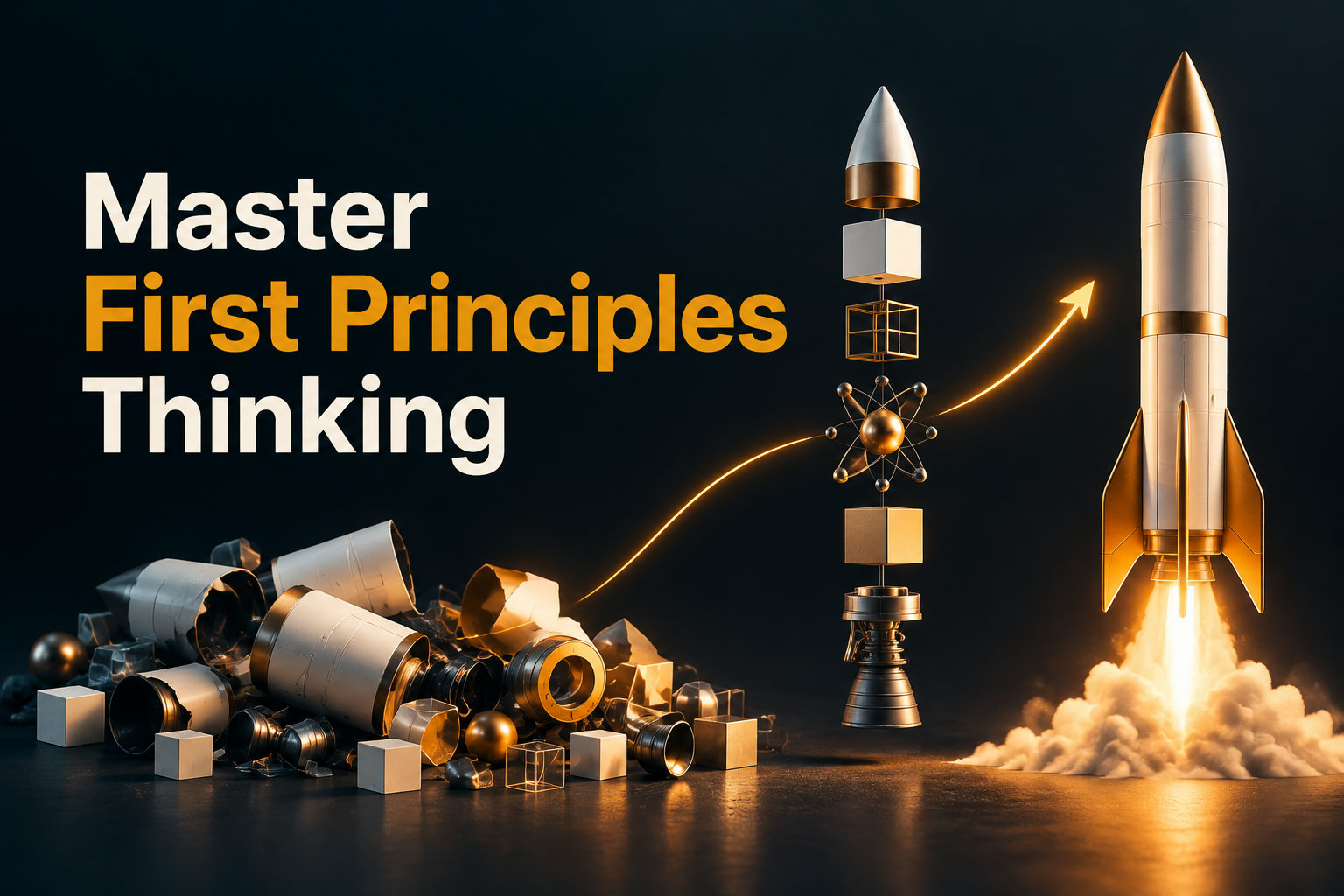
Most of our decisions follow well-worn paths: habit, the crowd, or "that's how it's always been done." It is fast and convenient, but it also traps us inside limits that nobody may have ever checked.
First principles thinking is a way out. This post explains what it is, how to apply it in 3 steps, and examples ranging from Tesla and SpaceX to everyday life.
What is first principles thinking?
First principles thinking means breaking a problem down to the most basic truths you are sure of. Then you reason up from those truths to find a solution.
The idea goes back to Aristotle, who described a "first principle" as the most basic thing, one that cannot be deduced from anything else. More recently, Elon Musk made it popular again by using it to build Tesla and SpaceX.
How is it different from reasoning by analogy?
Most of the time we reason by analogy: we look at how others do something and do it similarly. First principles starts from the nature of the problem itself.
| Reasoning by analogy | First principles | |
|---|---|---|
| Starting question | How are others doing it? | What is the problem, really? |
| Based on | Experience, habit, the crowd | Verified facts |
| Speed | Fast | Slow, effortful |
| Typical result | Small improvements | Breakthroughs, new approaches |
The two are not mutually exclusive. Analogy is good enough for everyday work; first principles is for the big problems.
3 steps to apply it
- Identify your assumptions. Write down what you take for granted about the problem. For example: "This must cost a lot of money," "We have to follow this process."
- Break them down to the fundamentals. For each assumption, keep asking "Why?" and "Is this really true?" Stop when only undeniable facts remain: laws of physics, material costs, real human needs.
- Rebuild. From those fundamental truths, ask: "If I started from scratch, how would I do this?" The answer may look completely different from the traditional way.
Classic examples: Tesla and SpaceX
Tesla's batteries. At the time, everyone believed electric car batteries were very expensive, around $600/kWh, and always would be. Musk asked instead: what are batteries made of? Cobalt, nickel, aluminum, carbon and polymers. Bought on the market, those materials cost only about $80/kWh.
Conclusion: batteries were expensive mostly because of how they were made, not by nature. The real problem was finding a cheaper way to put the materials together.
SpaceX's rockets. Buying a rocket back then cost tens of millions of dollars. Musk calculated the raw material cost of a rocket and found it was only about 2% of the selling price. So SpaceX decided to build and reuse its own rockets, driving launch prices down sharply.
These figures are approximate numbers Musk has cited in interviews.
Applying it to everyday life
You don't need to build rockets to use this way of thinking.
"Starting a business takes a lot of capital." What does a business really need? A customer willing to pay for a specific value. That can start with very little money, for example by selling to 10 people before building the full product.
"Learning English means going to a language center." What does learning a language really need? Enough listening and speaking, and someone to correct your mistakes. There are many ways to get those: watching movies, talking with international friends, practicing with AI.
Things to keep in mind
- It takes time and effort. You don't need it for everything. Save it for big problems, or when the old way has hit a wall.
- Verify your "fundamental truths." If you're not careful, you can swap an old assumption for a new one and still believe it is a fact.
- You need background knowledge. Breaking a problem down requires knowing enough about the field, so don't hesitate to learn and ask experts.
Final thoughts
First principles thinking isn't an innate gift of geniuses. It's a habit: daring to ask "Why?" about things everyone else takes for granted.
This week, pick one problem you're stuck on. Write down your assumptions, break them down, and see what a new solution looks like.
#FirstPrinciples #CriticalThinking #ProblemSolving #ElonMusk