Hermes Agent vs OpenClaw: Self-Improving Brain vs the Skill Megastore
Two open-source agents you self-host and message from WhatsApp — but they bet on opposite philosophies. Hermes learns and writes its own skills; OpenClaw plugs into 700+ community skills. Here's which one wins for you.
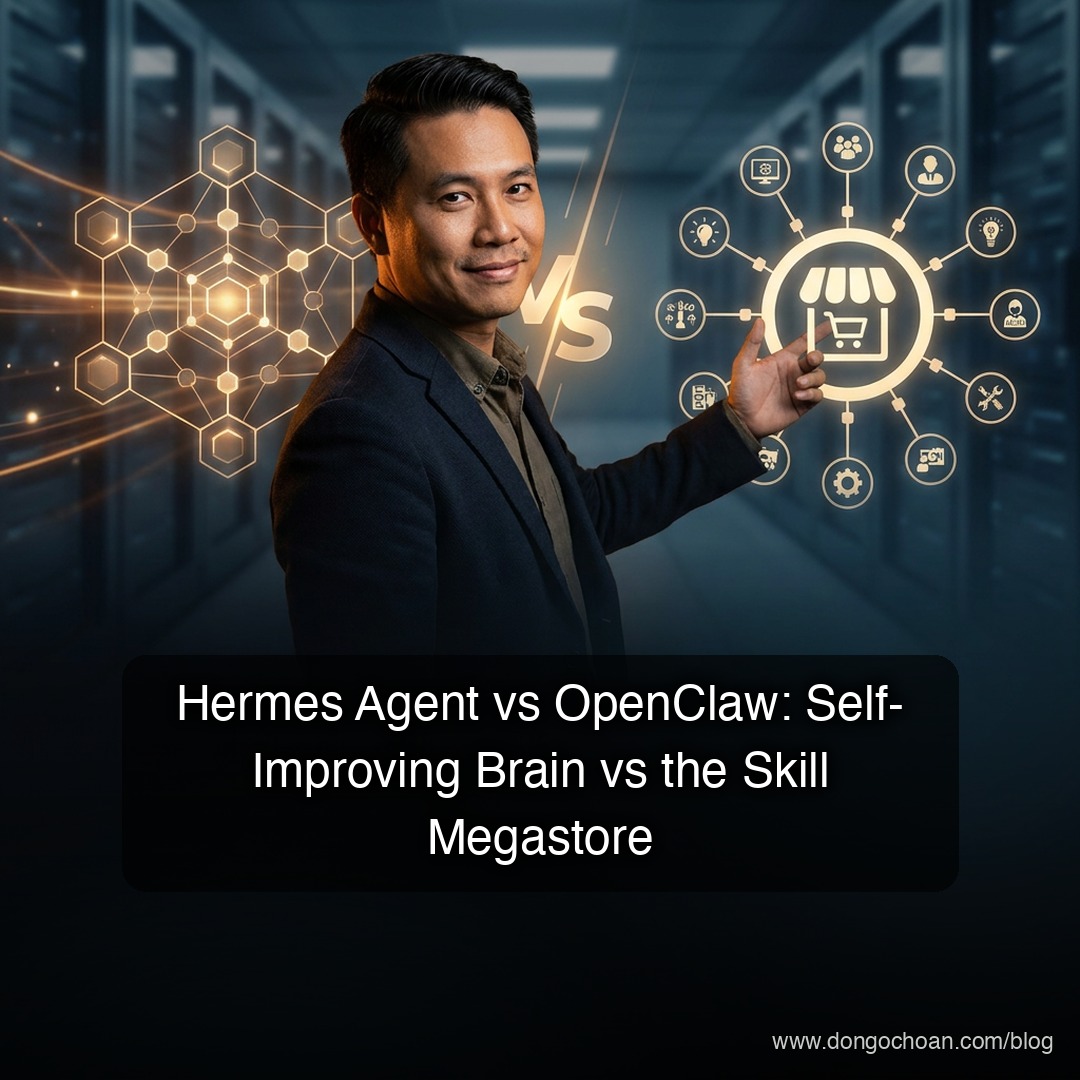
On the surface, Hermes Agent (by Nous Research) and OpenClaw look like twins: both are open-source, self-hosted AI agents that run as a persistent process on your own hardware, connect to the messaging apps you already use, keep memory across sessions, and execute real tasks through tool calls — not just chat. But once you look under the hood, they're betting on two fundamentally different philosophies of what an agent should be. One is engineered to learn and rewrite itself. The other is engineered to plug into everything.
This is a deep comparison for builders deciding where to commit.
The Core Philosophical Split
| Dimension | Hermes Agent (Nous Research) | OpenClaw |
|---|---|---|
| Core bet | A closed learning loop — the agent gets smarter the longer it runs | A massive plug-in ecosystem — 700+ community skills on ClawHub |
| Skills origin | Self-created from experience (autonomous) | Community-built, installed from a registry |
| Memory | FTS5 full-text + LLM summarization, ~10ms over 10k+ docs | Markdown files + SQLite vector embeddings in ~/.openclaw/workspace/ |
| Execution backends | 6 (local, Docker, SSH, Daytona, Singularity, Modal) | Local Node.js process on 127.0.0.1:18789 |
| Built by | Model trainers (Hermes, Nomos, Psyche models) | Peter Steinberger (now leading OpenAI's personal agents) |
| Standout feature | Autonomous skill creation + self-improvement | "Heartbeat" proactive scheduling + huge skill registry |
| Biggest risk | Younger ecosystem, fewer ready-made integrations | Documented security incidents at scale |
1. The Defining Difference: Where Do Skills Come From?
This is the single most important distinction, and everything else flows from it.
Hermes Agent generates its own skills. When it completes a complex task — Nous Research's threshold is roughly five or more tool calls — it autonomously writes a skill document: a reusable Markdown file capturing the approach, edge cases, and domain knowledge from that interaction. That document loads into future sessions. The result is a genuine closed learning loop: solve → write skill → store → do it better next time. Nous reports that an agent using self-created skills completed research tasks 40% faster than a fresh instance, with no prompt tuning.
OpenClaw installs skills from a marketplace. Its ClawHub registry hosts 700+ community-built skills (some sources cite figures into the thousands) covering Gmail, GitHub, Spotify, Philips Hue, Obsidian, calendar management, crypto trading, and more. Each skill is a small Markdown extension — roughly 20 lines — that installs without a server restart. You're not waiting for the agent to learn; you're browsing an app store and clicking install.
The trade-off: Hermes compounds in value on your specific workflows over time, but starts with less out-of-the-box coverage. OpenClaw gives you instant breadth across hundreds of integrations, but it doesn't get fundamentally smarter at your tasks on its own.
2. Architecture & Deployment
OpenClaw runs as a persistent Node.js process — the "Gateway" — binding by default to 127.0.0.1:18789 (localhost only, for security). An agent loop processes each request through up to 20 serialized cycles: assemble context, query the LLM, execute tools, stream back. Everything — config, memory, personality — lives as plain-text Markdown (AGENTS.md, SOUL.md, TOOLS.md, MEMORY.md) in ~/.openclaw/workspace/, which means you can Git-version your entire agent. Its signature Heartbeat wakes the agent every 30 minutes to read a HEARTBEAT.md and act proactively — morning briefings, monitoring, scheduled tasks.
Hermes Agent is built to be less tethered to one box. It supports six terminal backends — local, Docker, SSH, Daytona, Singularity, and Modal — so you can run it on a VPS, a GPU cluster, or serverless with minimal idle cost. It ships with 60+ built-in tools plus MCP server support, subagent spawning for parallel workstreams, and cron-based automations. Its skills follow the open agentskills.io standard, making them portable and shareable across compatible agents.
Verdict: OpenClaw's localhost-Markdown design is beautifully simple and auditable. Hermes's multi-backend flexibility is built for people who want to scale the agent beyond a single always-on machine.
3. LLM Flexibility
Both are model-agnostic, which is table stakes in 2026.
- OpenClaw explicitly supports Claude (Opus 4.6, Sonnet 4.5, Haiku), GPT-5.2 Codex, Gemini 2.0 Flash, DeepSeek V3, Kimi K2.5, and local runtimes (Ollama, LM Studio, vLLM) — with automatic failover. The docs recommend Claude Opus 4.6 for long-context strength.
- Hermes Agent works with Nous Portal, OpenRouter, OpenAI, or any compatible endpoint. The notable wrinkle: Nous Research trains its own models (Hermes, Nomos, Psyche), so the framework is built by people who understand the model layer intimately — and it pairs naturally with open-weight models.
This is roughly a tie, with a slight edge to OpenClaw on documented breadth and an edge to Hermes on open-model alignment.
4. The Security Reality Check
This is where the comparison gets serious, and where OpenClaw's scale has cut both ways.
OpenClaw's explosive growth — over 214,000 GitHub stars by early 2026 — made it a target. Documented incidents include 21,000+ OpenClaw instances exposed directly on the public internet, an audit finding 26% of ~31,000 skills contained at least one vulnerability, and the "ClawHavoc" supply-chain attack that pushed 341 malicious skills distributing macOS infostealer malware. Multiple critical CVEs, including one-click remote code execution, have been reported.
None of this means OpenClaw is "insecure" by design — it binds to localhost, supports tool-approval workflows, scoped permissions, and Docker sandboxing. But an agent with shell access, your messaging accounts, and a third-party skill marketplace is an enormous attack surface, and prompt injection through processed emails or documents cannot be fully eliminated.
Hermes Agent ships with command approval, authorization mechanisms, and container isolation — the same defensive primitives. Its younger, smaller ecosystem means a correspondingly smaller attack surface today, but also less battle-testing at scale. The honest read: both demand a dedicated machine, separate accounts, read-only access where possible, and skill review before install. Neither is something you bolt onto your primary work laptop casually.
5. Who Should Choose Which?
Choose Hermes Agent if:
- You want an agent that compounds in value on your recurring workflows over weeks and months.
- You care about open-model alignment and may run open-weight LLMs.
- You need to deploy across varied backends (serverless, GPU clusters, SSH) rather than one always-on box.
- You're comfortable being earlier on the adoption curve in exchange for the self-improvement edge.
Choose OpenClaw if:
- You want instant breadth — hundreds of ready-made integrations you can install in minutes.
- Proactive scheduling (the Heartbeat model) is core to your use case.
- You value a large, active community and an auditable, Git-versioned Markdown workspace.
- You have the security discipline to run it safely on an isolated machine.
The Bottom Line
This isn't a "which is better" question — it's a "which philosophy fits your problem" question. Hermes Agent is a bet on intelligence that grows. OpenClaw is a bet on an ecosystem that's already huge. If your work is repetitive and specialized, Hermes's learning loop will likely out-compound a static skill library over time. If your work is broad and integration-heavy, OpenClaw's megastore gets you productive on day one. The one thing both demand equally: treat a tool-wielding, shell-capable, message-connected agent as the serious security surface it is.
References: Hermes Agent Docs (Nous Research) · What Is OpenClaw? (MindStudio)
#HermesAgent #OpenClaw #AIAgents #NousResearch #OpenSourceAI #SelfImprovingAI #AgenticAI #AISecurity #SelfHosted #ArtificialIntelligence
✍️ The Author: Do Ngoc Hoan Founder of CookConnects.ca & Wizy.ca. Bridging the gap between advanced algorithms and business execution. I write for technical founders looking to scale their impact with AI and robust engineering.