Andrej Karpathy's Autonomous ML Loop: The Shift from Coding to Experimental Design
Andrej Karpathy's 630-line Python script ran 50 ML experiments overnight. This "Karpathy Loop" reveals a future where humans design experiments and AI executes them, guided by Markdown.
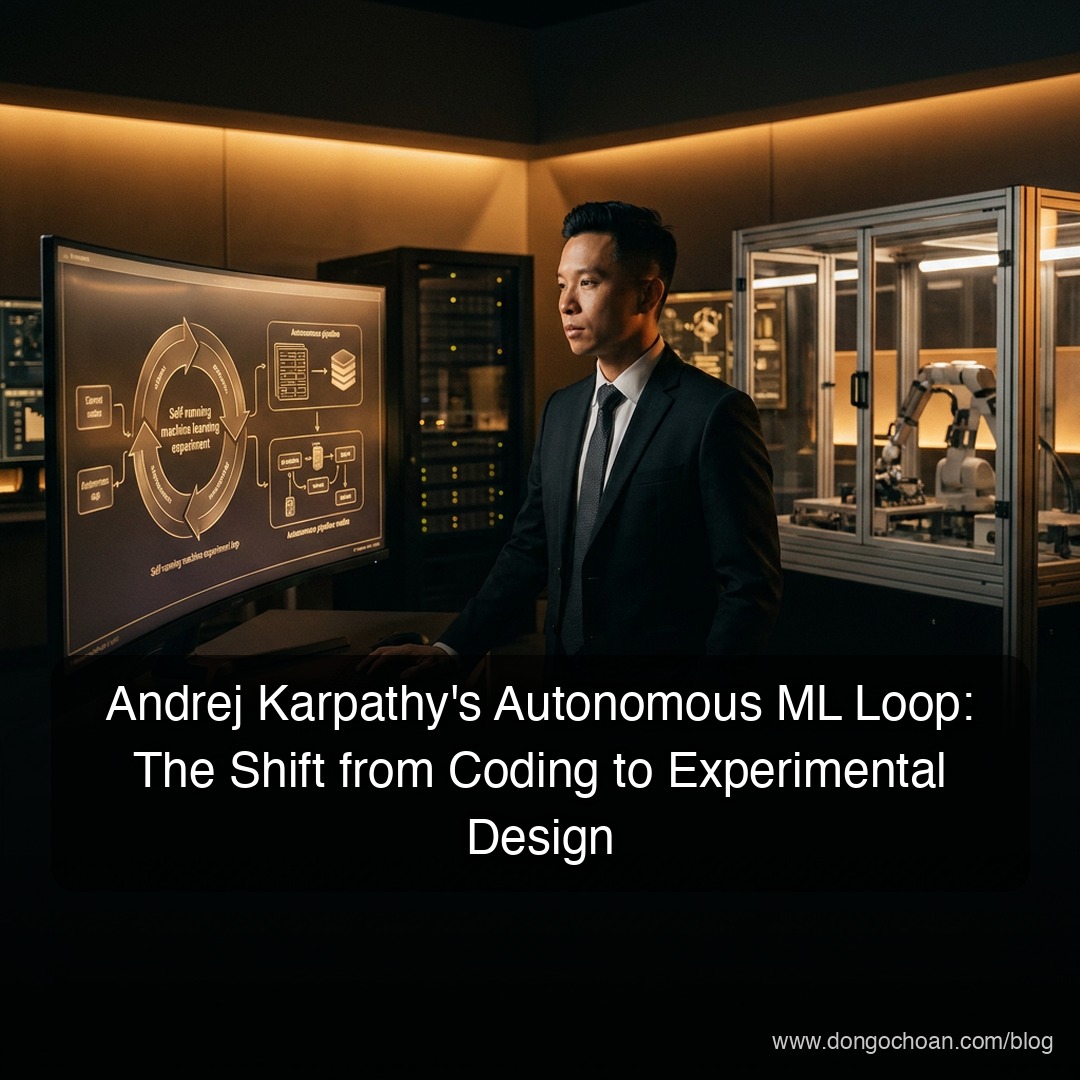
On the night of March 7, Andrej Karpathy pushed a 630-line Python script to GitHub and went to sleep. By morning, his agent had run 50 experiments, discovered a better learning rate, and committed the improvements to git—without a single human instruction in between.
While this story highlights autonomous ML research, the real breakthrough is the design pattern beneath it and the 40-line Markdown file that orchestrates the entire process.
1. The Karpathy Loop: Three Core Primitives
Karpathy's AutoResearch automates the tedious cycle of tweaking hyperparameters, running models, reading metrics, and deciding whether to keep changes. What makes this loop generalizable beyond ML training are three strict constraints:
- Editable Asset: The agent is only allowed to modify a single file. This confines the search space and keeps every hypothesis reviewable as a simple git diff.
- Scalar Metric: A single number (like validation bits per byte) determines improvement. It must be computable without human judgment and entirely unambiguous.
- Time-Boxed Cycle: A fixed duration makes every experiment directly comparable, whether the agent changed the model size or the learning rate.
These primitives ensure that Goodhart's Law doesn't derail the agent. The loop is minimal by design, optimized for relentless efficiency.
2. Markdown as the Human-Agent Interface
The unsung hero of the AutoResearch repository isn't the Python training script; it's program.md.
This single Markdown document simultaneously serves as instructions, constraints, and stopping criteria. No other format achieves this balance. YAML encodes structure but lacks reasoning; Python is executable but hard to read as a strategy; JSON has no narrative. Markdown sits at the perfect intersection of human editability and agent parseability.
We are seeing this pattern emerge globally (like CLAUDE.md or Cursor rules). Structured natural language is becoming the most durable way to encode human intent. This means writing a good program.md is now the highest-leverage skill in autonomous design.
3. The Pattern Extends Beyond ML
The Karpathy Loop isn't just for training language models. Any system with a scriptable asset, a measurable metric, and a time-boxed evaluation cycle can use it:
- Database Query Optimization: The agent modifies query structures; the metric is p95 latency; the cycle is a fixed benchmark run.
- Support Ticket Routing: The agent refines classification prompts; the metric is accuracy against a hold-out set.
- Agent Optimization: Frameworks like LangChain have already adapted this loop to optimize agents themselves in production.
Conclusion: The New Role of the Human
As Karpathy demonstrated, investing 30 minutes in experimental design can yield overnight results that would normally take days. The agent doesn't replace the researcher; it eliminates repetitive execution so the human can focus entirely on domain knowledge and judgment.
The shift from writing code to writing experimental protocols is not a downgrade. The output is no longer just a model, but a git log of validated decisions. We are moving towards a future where human engineers are the strategic architects, and AI handles the exhaustive execution.
Reference: The New Stack
✍️ The Author: Do Ngoc Hoan Founder of CookConnects.ca & Wizy.ca. Bridging the gap between advanced algorithms and business execution. I write for technical founders looking to scale their impact with AI and robust engineering.