MiniMax M2.7: When AI Stops Waiting for Human Code
MiniMax M2.7 marks a turning point in AI development, becoming the first model to independently edit its own code and guide its evolution without human intervention.
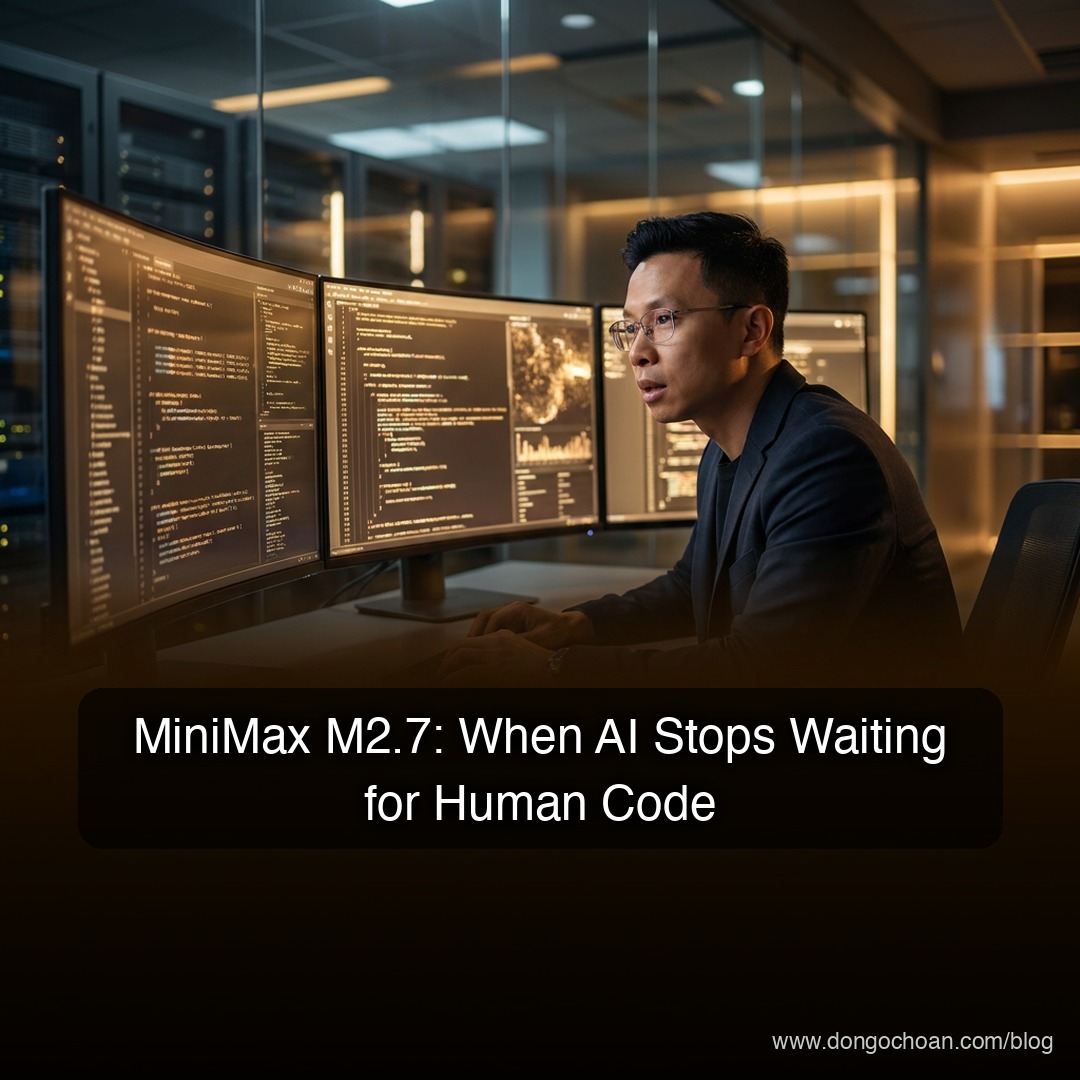
Have you ever imagined a robot picking up a hammer, looking in the mirror, and rewiring its own brain? It sounds like science fiction, but MiniMax just made it a reality with their M2.7 release—the first AI model to directly intervene in its own evolutionary process.
1. What Exactly is Happening?
Instead of waiting for human engineers to spoon-feed it code or manually label data, MiniMax M2.7 has embarked on an independent journey.
- Over 100 Autonomous Cycles: During development, the model independently analyzes its errors, rewrites its code, runs its own evaluations, and decides what to keep and what to discard.
- 30-50% Reduction in Human-Led Training: Imagine a restaurant where the chef goes to the market, simmers the broth, tastes the food, and improves the recipe without the owner ever getting involved. That’s how M2.7 was built.
2. Impressive Benchmarks
Don't assume "self-taught" means subpar. Benchmark metrics show MiniMax M2.7 confidently rivaling industry giants such as:
- Claude Opus 4.6
- GPT 5.4
- Gemini 3.1 Pro
These are all heavyweights in the tech world, yet a self-driven model has achieved comparable performance. This proves one crucial point: AI building new AI is undeniably the real future.
3. Why Should We Care?
If training AI was previously like tending to a delicate plant—requiring daily watering, fertilizing, and pruning—we now possess a "smart garden." The tree knows exactly when to draw water and which diseased branches to shed.
The Edge for Tech Professionals (Devs/PMs):
- Velocity: AI development is compounding exponentially because it is no longer bottlenecked by human typing speeds or sleep schedules.
- Optimization: It understands its own "pain points" better than anyone. Bloated code and obsolete logic are ruthlessly phased out by the system itself.
Conclusion
MiniMax's core philosophy left a lasting impression on me: "The best models of the future will build themselves." We are entering an era where the human role shifts from "builder" to "strategic orchestrator." Instead of fearing replacement, we must learn to coordinate these self-evolving digital apprentices.
What are your thoughts on letting AI take the steering wheel? Let's discuss in the comments below!
✍️ The Author: Do Ngoc Hoan Founder of CookConnects.ca & Wizy.ca. Bridging the gap between advanced algorithms and business execution. I write for technical founders looking to scale their impact with AI and robust engineering.