Why Struggle Content Outsells Success: Jun Yuh's 3-1-2-1 Storytelling System
Success posts make people envious; struggle posts make people root for you. A full breakdown of the Creator Vision framework, the 3-1-2-1 cadence, and where the ethical line sits when telling painful stories.
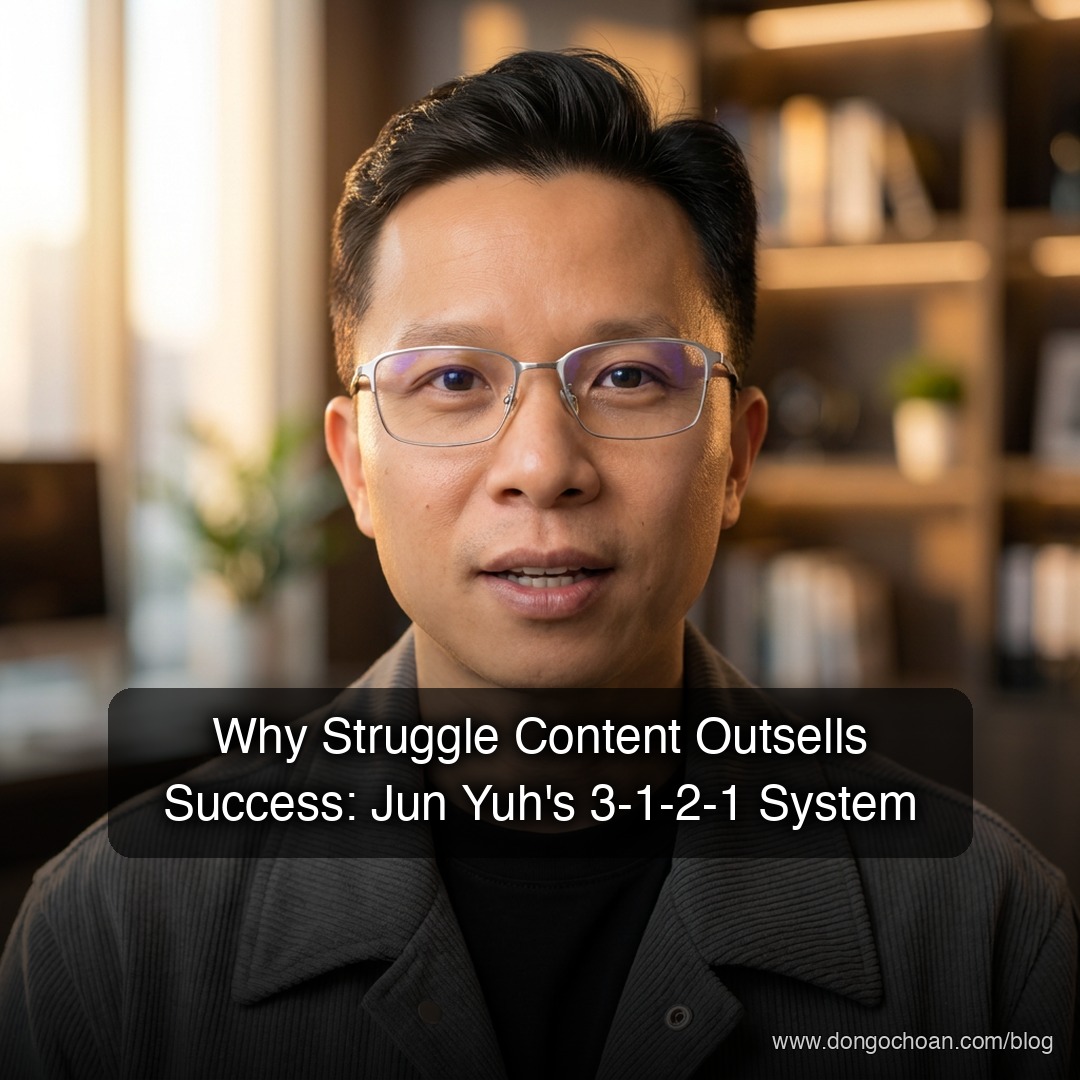
The highest-leverage change most creators can make is to stop posting proof of success and start posting proof of transformation. Jun Yuh — a Korean-American creator with over 8 million followers across platforms and a content business he says has crossed $13M in under three years — built everything on that single inversion. Success content makes people envious. Struggle content makes people root for you. And an audience that roots for you is the only audience that buys from you.
I spent an evening going through his hour-long breakdown on the Hot Smart Rich podcast, pulling out the actual frameworks rather than the highlight-reel quotes. This post is my working notes: what he does, why it works, and what I'm changing in my own content because of it.
Who is Jun Yuh, and why should a marketer care?
Jun Yuh started posting from a shattered iPhone 12 in his college dorm. His first attempts were fashion and fitness videos, filmed for seven or eight hours in his parents' basement, pulling a few hundred views each. He was, in his own words, imitating "what the cool kids were doing."
The turn came when he picked up the phone and simply talked — about how hard life was at that moment. The comments changed from 🔥 emojis to "this video actually changed me."
He noticed. He did more of it. He started making content about studying — which he assumed was the most boring possible topic — and grew from there. Today he teaches personal branding through Creator College, and his top videos sit at 36M, 25M, and 24M views. All of them tell variations of the same story.
The reason a marketer should care is that he's not a natural performer who got lucky. He was, by his account, not well-spoken, embarrassed, and afraid of being seen. That forced him to reverse-engineer the whole thing into a system — which means the system is teachable.
Why does struggle content outperform success content?
Here's the mental exercise he gives:
Imagine two creators. Creator A shows up in a nice car, flashes a watch, and says "I've figured it out — listen to me, do X, Y, Z, because look at my life." Creator B talks about what they had to endure, and what they learned coming out the other side.
The difference isn't taste. It's a difference in what the viewer does afterward:
- Constant success posting triggers envy. Jun notes that creators who lead with wins reliably attract hate in the comments.
- Struggle-and-transformation posting triggers identification. The viewer sees themselves, and starts wanting you to win.
"The human common denominator is struggle."
That's the whole mechanism. There are hundreds of millions of people fighting the exact same fight you fought three years ago. When Jun posts that his business did $9M in 14 months, the comments aren't jealous — they're celebratory, because that audience walked the poor-and-unknown part of the road with him.
The marketing translation: storytelling isn't the emotional garnish on top of your selling. It is what earns you the permission to sell at all.
What is the Creator Vision framework?
This is the first exercise he runs every creator through. One sheet of paper, your name at the top, three branches: What, Who, Why. Personal branding, he argues, is the intersection of what you say, who you say it to, and why it matters to you.
Branch 1 — WHAT: a message, not a niche
Don't say "I'm a travel creator." State a belief: "I believe more people should live a life of freedom so they can do more of what they enjoy."
From that belief, your content pillars can be travel — but also productivity, money management, and how freedom changed your relationships. One message legitimately supports five pillars.
"Don't niche down. Become the niche."
This is the most quotable idea in the whole interview, and the most misunderstood. The conventional advice — pick one narrow topic and never leave it — caps your ceiling because topics have finite audiences. Beliefs don't.
Branch 2 — WHO: demographics and psychographics
Demographics (age, job, location) are the easy half. The half that actually converts is psychographics: the pains and the desires.
His test is sharp: after watching your content, can a stranger describe not just what your audience looks like, but what they have struggled with? If not, your Who branch is decorative.
Branch 3 — WHY: your own stories
This is the branch he considers his own superpower, and the one almost everyone leaves blank. Why does this message matter to you?
For Jun, the message is "a personal brand is the greatest long-term asset anyone can build," and the supporting stories are: insecure → confident, because of content; poor → able to take care of his family, because of content; undisciplined → disciplined, because of content.
When all three branches are filled in, the bottom of that sheet of paper becomes a permanent bank of content starters. The "what do I post today?" problem is a symptom of a blank Why branch.
Live proof from the interview: he graded the host's Instagram against the framework. What — excellent. Who — excellent. Why — nearly absent. His verdict was that the missing Why branch was the entire gap between 100K followers and a million.
The 30-minute exercise that finds your stories
Deliberately low-tech, and you can do it today:
- Set a 30-minute timer and open a blank doc.
- List every transformative moment in your life — not events, but changes of state: insecure → confident, undisciplined → disciplined, performing a persona → being yourself, terrified of visibility → posting anyway.
- Each transformation is a theme, not a video.
- For each theme, brainstorm multiple messages and formats.
- Ship at least 3 per week.
The output you want isn't "30 ideas for August." It's 6–8 transformation themes you can repackage for a year.
What are the four content missions, and the 3-1-2-1 cadence?
Jun stacks content into a funnel where every post has one assigned job. For someone who still needs audience growth — most people — he suggests roughly seven posts a week, split like this:
| Mission | Job | Cadence |
|---|---|---|
| Attract | Reach new people. This is where storytelling and transformation live. Trends work too, but only if you add your own message — a copy-pasted trend brings the wrong people in. | 3× / week |
| Nurture | Prove you're a human. Real life, real time, no lesson attached. "I'm exhausted and anxious because I have 14 podcasts to record this week." Skip this and you bleed followers. | 1× / week |
| Position | Demonstrate expertise. Teaching talking-heads, plus brand-building moments (launching a podcast, hosting an event, getting featured). | 2× / week |
| Convert | The ask. An offer, a landing page, a brand deal. | 1× / week, max |
The discipline is in that last row:
"A lot of people want to convert on every single post, and they forget there's a real human being on the other side of the screen. You have to earn that goodwill."
He converts once a week and says the traffic beats what most creators get from six conversion posts — because the top of the funnel did its job first. Content needs a mission. A post without an assigned job is a post that does no job.
Why does telling the same story over and over still work?
The host asked the uncomfortable version of this question directly: your 36M, 25M and 24M-view videos all tell the same story — doesn't the audience get fatigued?
Two answers, and both are counterintuitive:
1. Familiarity is a creator's illusion. You think about a piece of content for three, four, five hours. The viewer watches it for 30 to 45 seconds, maybe once every week or two. You are bored of your story long before your audience is even aware of it.
2. Same theme, different packaging. One transformation, re-cut endlessly — new hook, new angle, new format, new opening line.
The practical lesson is uncomfortable and valuable: the story you feel you've "already posted" is exactly the story you should post again. Most people tell their best story once and then abandon it, which is a staggering waste of the only asset that is genuinely un-copyable.
Where is the ethical line when telling painful stories?
This was the sharpest question in the interview, and the answer is the part I'd tattoo on a wall. If struggle performs, what stops storytelling from degrading into exploiting — or inventing — pain for views?
Jun gives two hard lines:
1. No one else is a prop. Not a single one of his storytelling videos speaks badly about his mother, his father, or a past relationship. Every story stays focused on his own emotional, spiritual and physical maturation. He deliberately keeps his girlfriend's name private. Nobody can accuse him of monetizing someone else's story, because he never tells someone else's story.
2. Always land on the transformation, never park on the pain. The story must resolve into "and here's who I became because of it." That resolution is what stops content from being sappy or depressing and turns it into something useful for the viewer.
He also names the release valve for people who feel this gets performative: nurturing content. Once a week he posts with no transformation arc at all — just real life, in real time. That's what keeps the storytelling from calcifying into a highlight reel of curated wounds.
The "Younger You" principle: who do you talk to on day one?
If you have no idea who your audience is, Jun's answer is disarmingly simple: talk to yourself from two to three years ago.
Two reasons it works:
- You understand that person better than any persona document could describe them — their fears, their desires, the specific thing they were embarrassed about.
- You are demonstrably no longer that person. That gap is the transformation, and the transformation is your curriculum.
Paired with this is his other correction to the beginner's paralysis:
"You don't have to wait to be somebody. You already are somebody."
He assumed nobody would care that he studied for his classes. That assumption was wrong, and it was wrong in the most profitable way possible.
Four foundations underneath all of it
Speaking to camera is a skill, not a personality trait. "I was judging myself for a skill I didn't have yet." He avoided his own homepage for a long time because he was too embarrassed to look. And: "volume dictates luck."
Ownership beats affiliate. He drove $3,000–$5,000 in sales for a fitness brand as an affiliate and kept 10% — a few hundred dollars. The thought that changed his life was: I'm working just as hard as they are — why don't I own the thing? Everything after that is the $12–13M.
Delayed gratification is the actual moat. People see three years of business doing eight figures. Nobody sees the four years before that, alone in a dorm room, being laughed at.
Money is downstream of impact. He still drives a ten-year-old Jeep with dents in it, kept using the shattered iPhone until followers DM'd him to please buy a new phone, and gave his dad $500,000. The financial story stays credible because the spending story never contradicted it.
How I'm applying this to my own content
I'm writing this partly for readers and partly for me, so here's the honest self-diagnosis.
Running my own content through the Creator Vision framework, my What and Who are solid — I have real expertise, real clients, and a real product. That's positioning content, and it's my strongest muscle. My Why branch is the one that's thin. Which means most of what I publish is doing 2 of the 4 jobs — position and convert — and almost none of the attract-and-nurture work that makes the other two land.
The fixes, in order:
- Write the Creator Vision on one page, forcing myself through the Why branch. Not "I do AI marketing" but a belief.
- Run the 30-minute transformation exercise. For me the raw material is obvious once I stop avoiding it: leaving Vietnam and building a career in Canada; going from employee to owning a product; going from writing code to selling marketing; the first client who said no, and the first who said yes.
- Adopt 3-1-2-1, which mostly means publishing less selling, not more of everything.
- Write to my own self from three years ago — someone starting out, no clients, no idea how to price. Which happens to be an exact description of my ideal customer.
- Build a story library, not a content calendar. Six to eight themes, repackaged all year.
What not to copy blindly
Two honest caveats, because framework worship is its own trap.
Cultural calibration. Jun Yuh built an English-speaking, US-centric audience on short-form video, in a market that rewards high-intensity emotional self-disclosure. Vietnamese culture — and a B2B audience in Canada — has a different threshold for how much vulnerability reads as trustworthy versus performative. The framework is universal. The emotional intensity needs tuning for your market.
Survivorship bias. This is a successful person narrating backwards. His system explains convincingly why it worked for him; it does not guarantee it works for everyone who runs it. Treat it as a well-argued hypothesis you're going to test, not a law.
FAQ
Q: What is the Creator Vision framework? A one-page exercise with three branches — What (your message and content pillars), Who (audience demographics and psychographics), Why (your own transformation stories). The intersection of the three is your personal brand, and the bottom of the page becomes a permanent bank of content ideas.
Q: Why does struggle-based content outperform success-based content? Because struggle is the human common denominator. Success posts trigger envy and attract criticism; struggle-and-transformation posts trigger identification, and viewers who see themselves in your story start rooting for you to win.
Q: What is the 3-1-2-1 content cadence? Roughly seven posts a week: 3 attract (storytelling), 1 nurture (real life, no lesson), 2 position (expertise), 1 convert (the offer). It deliberately limits selling to once a week so the funnel above it can earn goodwill first.
Q: Isn't it repetitive to tell the same story multiple times? No. You've thought about the story for hours; your audience sees a 30-second version once every week or two. Keep the theme, change the packaging. Jun Yuh's 36M, 25M and 24M-view videos are all variations on the same story.
Q: How do I tell painful stories without exploiting them? Two rules: never make another person the villain of your story — keep the focus on your own growth — and always resolve into the transformation rather than parking on the pain.
Q: What if I don't know who my audience is yet? Use the "Younger You" principle: create for yourself from two to three years ago. You understand that person's struggles precisely, and the distance you've travelled since is exactly what you're qualified to teach.
References:
- How I Built A $13M Creator Empire From A Broken iPhone — Jun Yuh on Hot Smart Rich
- Jun Yuh's YouTube channel
- How To Blow Up ANY Personal Brand in 2026 ft. Jun Yuh
#Storytelling #PersonalBranding #ContentStrategy #Marketing #CreatorEconomy #ContentMarketing
✍️ The Author: Do Ngoc Hoan Founder of CookConnects.ca & Wizy.ca. Bridging the gap between advanced algorithms and business execution. I write for technical founders looking to scale their impact with AI and robust engineering.