Vibe Coding: Why Ideas Now Matter More Than Syntax
Andrej Karpathy just coined "Vibe Coding"—a paradigm shift where developers dictate the "what" and AI handles the "how." Discover why this is revolutionizing prototyping and what skills you actually need to survive.
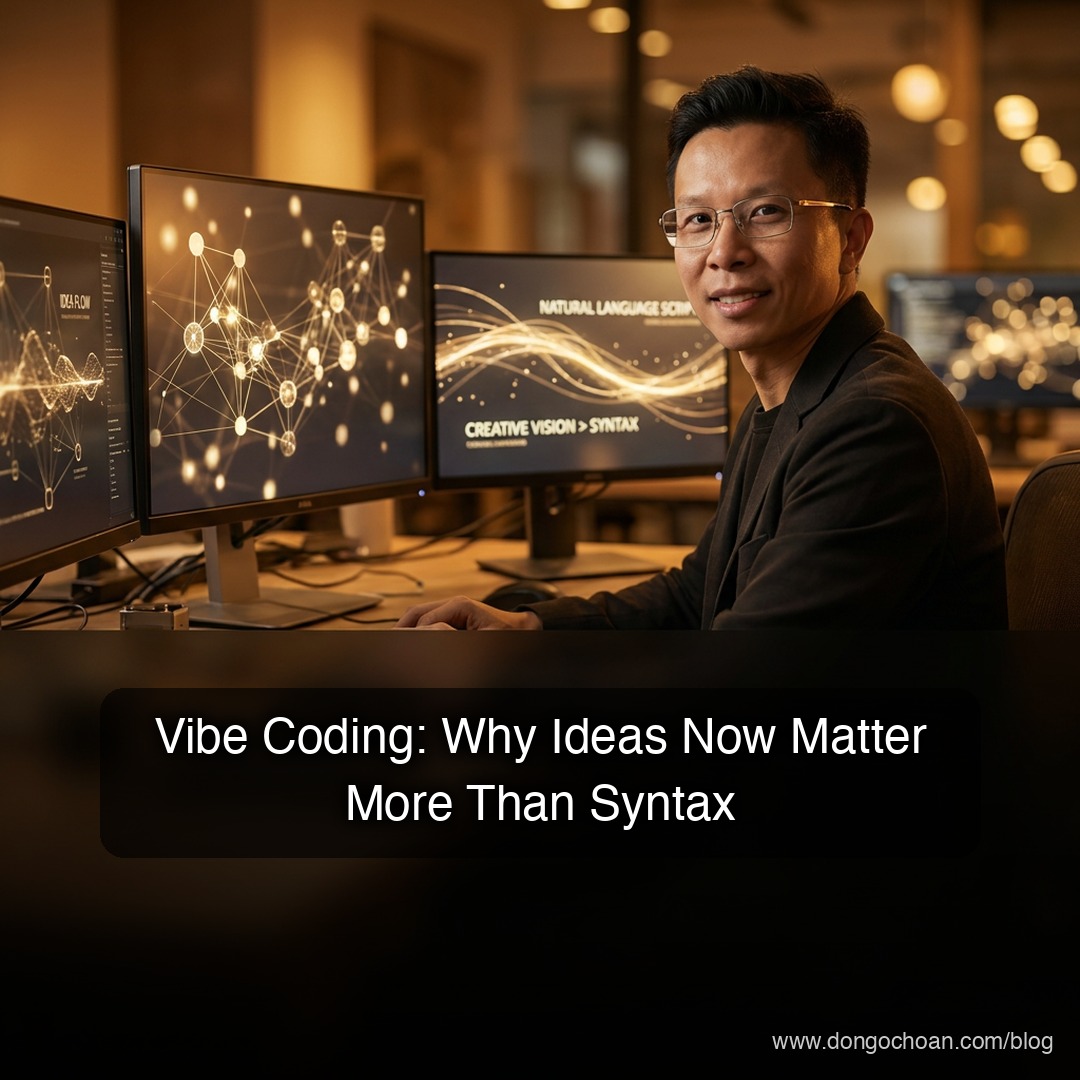
For decades, programming has been a rigorous exercise in exact syntax and logical structuring. But according to Andrej Karpathy, a new paradigm is taking over: Vibe Coding. If you think coding is still just about memorizing boilerplate and fighting syntax errors, it's time to rethink everything.
What Exactly is Vibe Coding?
Think of it this way: Instead of learning a complex recipe, buying raw ingredients, and sweating over a hot stove (Traditional Coding), you now play the role of a gourmet food critic.
You sit down and describe your desired outcome to an AI "chef" (like Cursor, Claude, or ChatGPT): "I want a spicy seafood dish, presented like a 5-star restaurant meal." The AI does the heavy lifting. You simply taste the result and adjust the "vibe": "This needs more kick, add some heat."
At its core, Vibe Coding means:
- Focusing on the "What": Emphasizing the desired outcome—what the app should look like and what features it needs.
- Ignoring the "How": Letting go of implementation details. Whether the AI uses Python, React, or Assembly doesn't matter, as long as the application runs smoothly and matches your intended "vibe."
- Natural Language as Code: The most powerful programming language right now is simply your native language.
Why the Industry is Embracing the Vibe
The benefits are undeniable, particularly for Product Managers and Startup Founders:
- Blazing Fast Iteration: Building a functional prototype used to take weeks. Now, it takes a few cups of coffee. You feed requirements to the AI, it generates the code, and you hit run.
- Democratizing Tech: Managers and non-technical founders can now build internal tools without knowing how to code. They just need to know how to articulate the right "vibe."
- Unleashing Creativity: When developers aren't bogged down by trivial syntax errors, their cognitive load drops, freeing them up to design truly innovative, unprecedented features.
The Danger of the "Vibe Coding Hangover"
However, too much of a good thing can be dangerous. Experts are already warning about the "Vibe Coding Hangover"—the messy aftermath of relying entirely on AI generation.
- Tech Debt and Spaghetti Code: AI often writes "fast food" code. It might run perfectly on day one, but underneath, it can be a tangled mess of patched-together logic.
- The Maintenance Nightmare: When the application scales and inevitably requires debugging, not understanding the underlying logic becomes a massive liability. You cannot simply "vibe" your way out of a critical memory leak.
- The Illusion of Mastery: Many mistake the ability to write a good prompt for Senior Developer expertise. Without a foundational understanding of system architecture, the "vibe" will eventually break down.
How to Survive and Thrive in the Vibe Era
Whether you are a seasoned developer or a product manager, the best approach is to adapt rather than resist.
- Become an Architect, Not a Bricklayer: Learn how to design robust systems. You need to know what makes a "beautiful" architecture so you can correctly guide the AI's output.
- Maintain Foundational Knowledge: AI handles the typing, but you must handle the strategic thinking. A solid grasp of Databases, Security, and System Design is crucial to "check the math" on what the AI produces.
- Experiment Immediately: Download an AI-first IDE like Cursor, integrate Claude 3.5 Sonnet, and try building a small project. The speed and flow of Vibe Coding is something you have to experience firsthand.
Conclusion: Vibe Coding is not the end of the software engineer; it is the beginning of an era where IDEAS matter more than SYNTAX. Don't fear losing your job to AI—fear losing it because you didn't have the right "vibe" to direct the AI.
Reference: Andrej Karpathy on X
✍️ The Author: Do Ngoc Hoan Founder of CookConnects.ca & Wizy.ca. Bridging the gap between advanced algorithms and business execution. I write for technical founders looking to scale their impact with AI and robust engineering.