Weird AI Characters: The "Is This Real?" Hook Behind 100M-View Accounts
Odd-looking AI characters go viral because viewers argue over whether they are real. Making one takes 2 steps; the forex affiliate play built on it is the risky part.
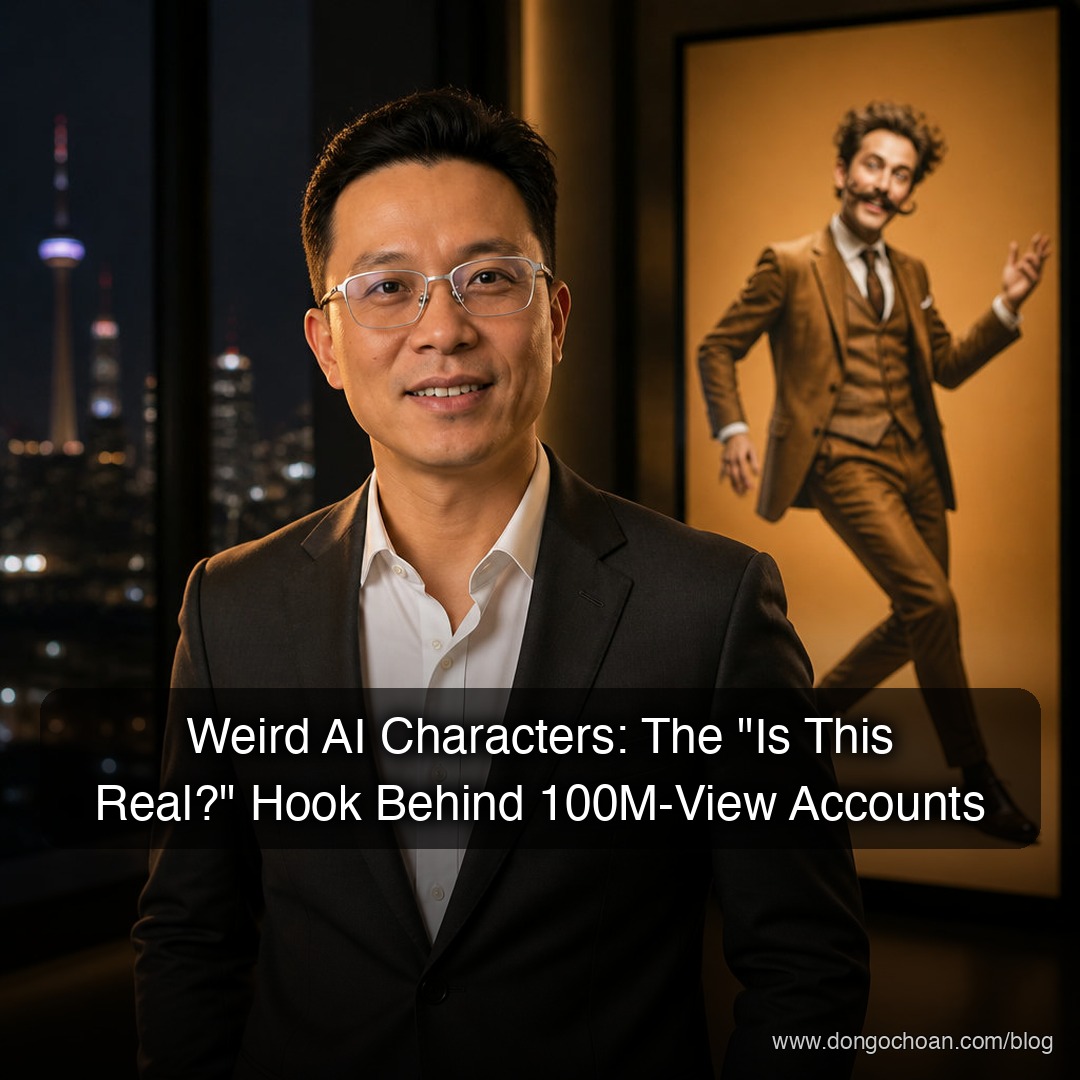
The fastest-growing short-video format of late 2026 is the "weird AI character": a deliberately odd-looking synthetic person whose only job is to make viewers ask "is this guy even real?". That doubt drives comments and rewatches, which is exactly what the algorithms reward. The production side is now a two-step job, but the way most playbooks monetize it (copied footage, unlabeled AI, forex affiliate links) is where the real risk sits.
What is the weird AI character trend?
Instead of polished AI influencers, creators now build characters that look like a video-game NPC who wandered into real life: a 7-foot man with an unexplainable face, a grandmother who seems never to have seen a phone, a glitchy gym bro. On 3 October 2026 the X account ViralOps claimed these characters are pulling 100M+ views even on brand-new accounts. That figure is the poster's own claim, but the pattern is visible: in September 2026 the AI persona "Jean Philanthrope", a moustached man shadowboxing in a houndstooth suit, went viral across TikTok, Instagram and X within days, with a public argument over whether he was real, and speculation that he existed to promote a Solana meme coin.
Why does "is this real?" beat a beautiful AI influencer?
Three mechanics stack up:
- Memorability. A strange face is harder to scroll past and harder to forget than a generic attractive one.
- Argument as engagement. Viewers go to the comments to debate whether it is AI. Every argument counts as engagement.
- Rewatch as watch time. People replay the clip to check for artifacts. Every replay counts as watch time.
As James Ebringer put it in his thread, "The chart is the proof and the character is the hook." The character stops the scroll; whatever sits next to it carries the message.
How are these videos made?
The workflow ViralOps describes has two steps:
- Build a character sheet. Take a reference image of an odd-looking character and have an image model produce a consistent three-panel sheet: front view, back view, face close-up.
- Swap the character into existing motion. Higgsfield's Genjutsu tool takes a reference video and re-casts it with your character while keeping motion, camera movement, lighting and framing. It accepts 4 to 30 second clips and up to 30 reference images, in either Motion Transfer or Object Swap mode.
The strategic shift is the second half of the ViralOps post: the opportunity is no longer one-off clips but one recognisable character turned into a repeatable format.
How are people monetizing it?
Ebringer's thread is the clearest example. His Q4 plan: screen-record a trading terminal while a forex signal plays out, put an NPC character reacting in the corner, and link to a free Telegram signals channel. The affiliate offer pays $1 per active subscriber and a flat $250 when a subscriber opens a broker account. His headline math is $250 × 4,000 = $1,000,000, or about 44 signups a day spread across 10 accounts with 5 to 10 characters. He sells it as needing no face, no camera and no trading knowledge.
What are the risks nobody mentions in those threads?
- The $250 is not free money. Brokers pay that bounty because, on average, the customer's deposits and trading losses are worth more than $250 to them. "It costs the user nothing" is only true until they trade.
- Financial promotion is regulated. The UK's FCA has criminally charged finfluencers for promoting forex CFD schemes, and a joint crackdown with regulators from Canada, Australia, Hong Kong, Italy and the UAE led to arrests, cease-and-desist letters and 50 warning alerts. Running "no trading knowledge" signal content with an undisclosed affiliate link fits squarely inside what they are targeting.
- Unlabeled realistic AI breaks platform rules. TikTok requires a label on AI content depicting realistic people, YouTube requires disclosure of realistic synthetic content, and Meta auto-applies an "AI info" label. A format whose hook is hiding that it is AI is working against all three.
- Re-casting someone else's viral video is still their video. Swapping the person does not remove the original creator's copyright in the footage, choreography and edit.
- Multi-account flooding gets treated as spam. Copying one winning clip across 10 accounts is the behaviour platforms' inauthentic-content policies describe.
How can a legitimate business use the idea?
The mechanic is sound even if the common playbook is not. A version I would actually recommend:
- Create one distinctive brand character and keep it for months. Recognition compounds; a new face every week does not.
- Use your own footage as the motion source. Film a staff member once, re-cast it with the character. No copyright problem.
- Label it as AI. TikTok states the label does not reduce distribution, and a great character survives disclosure. The debate simply shifts from "is it real?" to "how did they make this?".
- Attach it to a real product or service, not a commission from someone else's financial losses.
FAQ
What is a weird AI character? A deliberately strange-looking, AI-generated person used as a recurring face for short videos, designed to make viewers question whether it is real.
Why do these videos go viral? Uncertainty. Viewers comment to argue and rewatch to check, and both signals push the clip further.
What tools are used? An image model for the character sheet and a video re-casting tool such as Higgsfield Genjutsu for motion transfer.
Is the forex affiliate play safe? No. It combines regulated financial promotion, undisclosed incentives and unlabeled AI. Regulators in several countries are actively prosecuting similar schemes.
Do I have to label AI characters? On TikTok, YouTube and Meta platforms, realistic AI-generated people must be disclosed or will be labeled automatically.
Reference sources: ViralOps on X · James Ebringer on X · Higgsfield Genjutsu · FCA finfluencer charges – Finance Magnates · Global finfluencer crackdown – TradeInformer · Platform AI labeling in 2026 – Billo
#AICharacters #AIVideo #ShortFormVideo #Higgsfield #ContentMarketing #Finfluencer
✍️ The Author: Do Ngoc Hoan Founder of CookConnects.ca & Wizy.ca. Bridging the gap between advanced algorithms and business execution. I write for technical founders looking to scale their impact with AI and robust engineering.